How a robot vacuum sees: LiDAR, cameras, structured light and which models dodge cables
Robot vacuum obstacle avoidance from the makers' own figures: bumper-only, structured light, single and twin cameras, camera plus depth sensor, and which of 79 machines has which.
Maciej Ziółko · RoboVerdict editorial · Published · 6 min read
Two different jobs
A robot vacuum has to answer two questions all the time: where am I in the flat, and what is lying on the floor in front of me. Makers answer the first with the navigation sensor on top of the machine and the second with sensors on its nose, and the two are sold as one feature although they are not. A machine can map a flat perfectly with a LiDAR tower and still roll over a phone cable, because the tower looks across the room at wall height and sees nothing on the floor. Below is what each system does, and which of the 79 robot vacuums in our catalogue carries which, from the makers' own specifications.
Navigation: the tower, the sunken tower and no tower at all
Forty-seven of the 79 machines use the classic LiDAR tower: a laser spins on top of the robot, measures the distance to walls and furniture and builds the map the app shows. It works in the dark, and it is the reason a modern robot cleans in straight lanes instead of bouncing around. Its price is height: the tower sits on the body, so the sofa a towerless robot slides under is a wall to a robot with one.
Twenty-three machines keep the laser but lower it: the retracting LiDAR drops into the body when the robot goes under furniture, on the Roborock Saros 20 Sonic, Saros 10, Qrevo Curv 2 Pro, the Dreame X60 Pro Ultra Complete, X50 Ultra, L60 Ultra and the MOVA Z60 Ultra Roller Complete, among others. Five machines have no tower: the Roborock Saros 20 and Saros Z70 navigate with a solid-state 3D time-of-flight sensor and a camera, which is how the Saros 20 gets down to 80 mm, and the MOVA S70 Ultra Roller, S70 Roller and S70 Pro Roller do the same. Narwal goes the other way: the Flow 2, Flow and Freo 20 map with cameras alone, and the Freo Z10 Ultra pairs a LiDAR with a camera.
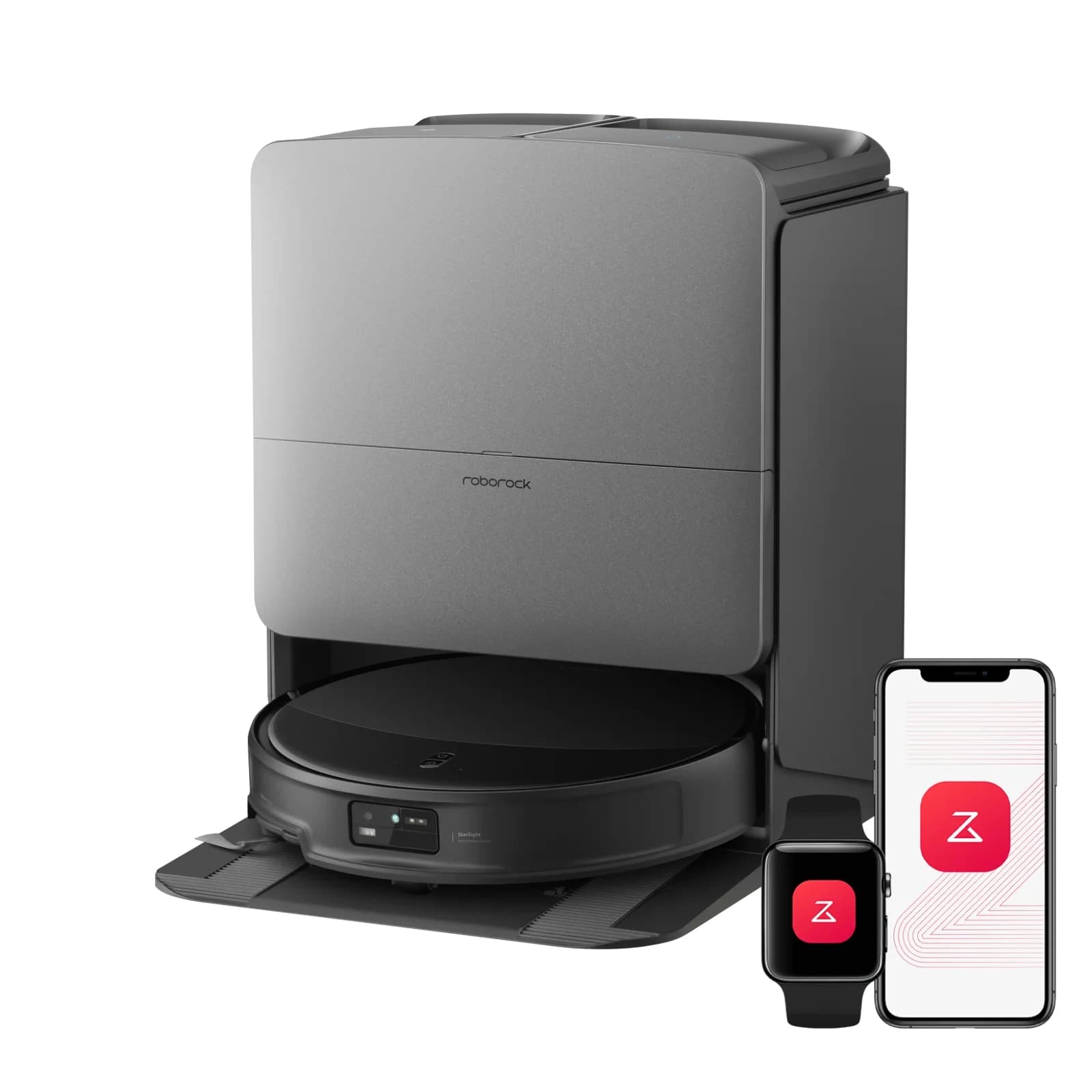
Roborock Saros 20
Roborock's flagship: 36,000 Pa, twin spinning mops the dock washes at 100 °C, and a solid-state 3D sensor instead of a LiDAR turret.
Obstacles: from a bumper to a camera with a depth sensor
Ten of the 79 machines publish no obstacle sensor at all: they find things by touching them, with a bumper in front and cliff sensors underneath. That is enough for walls, chair legs and stairs and useless for a cable, a sock or what the dog left behind. They are the cheapest group, the Roborock Q7 M5, Q7 L5+, Dreame D20 Air Plus, L10s Pro Gen 3, L50 Ultra AE, L60 Ultra FE, MOVA P50 Ultra, S70 Roller, S70 Pro Roller and Narwal Freo X10 Pro, and they suit a tidy home where the floor is cleared before the robot starts.
Twenty-four machines use structured light: an infrared pattern is projected onto the floor ahead and a sensor reads how objects bend it. The robot learns that something a few centimetres high is there and steers around it without knowing what it is, so a doorstop and a sock get the same berth. It is the mid-range standard, on the Roborock QV 35A, Qrevo S5V, Q10 S5+, Dreame L10s Ultra Gen 3, D30 Ultra, L40 Ultra CE, MOVA E40 Ultra, E50 Pro Ultra, eufy Omni C28 and Narwal Freo Z10 Pro, among others.
Eleven machines add a single camera with object recognition: a neural network names what it sees, cables, socks, shoes, pet waste, and the robot picks the margin for each. Recognition is the point, because it lets a cable be given a wider berth than a doorstop. The group includes the Roborock Qrevo Edge, Qrevo CurvX, Saros 10, MOVA V70 Ultra Complete, P70 Pro Ultra, P50 Pro Ultra, S70 Ultra Roller, eufy Omni E28, Dreame L60 Ultra PE and Narwal Freo Z10 Turbo. Six machines use two cameras, which gives depth the way two eyes do, so an unrecognised object still gets a measured distance: the Dreame X60 Ultra, X60 Max Ultra Complete, Narwal Flow 2, Flow, Freo 20 and Freo Z10 Ultra.
Twenty-eight machines, the largest group and the whole flagship tier, pair a camera with a depth sensor: the camera says what the object is, the depth sensor, a 3D structured-light or time-of-flight unit, says exactly where it lies, in the dark as well. That is what the Roborock Saros 20, Saros Z70, Qrevo Edge 2, Qrevo Curv 2 Pro, S8 MaxV Ultra, Dreame X60 Pro Ultra Complete, X50 Ultra, Matrix10 Ultra, Aqua10 Roller, L60 Ultra, L40 Ultra AE, MOVA Z70 Ultra Roller Complete, V50 Ultra Complete, Mobius 60 and the Ecovacs DEEBOT X11 PRO OMNI carry, among others. The obstacle avoidance ranking orders this group.
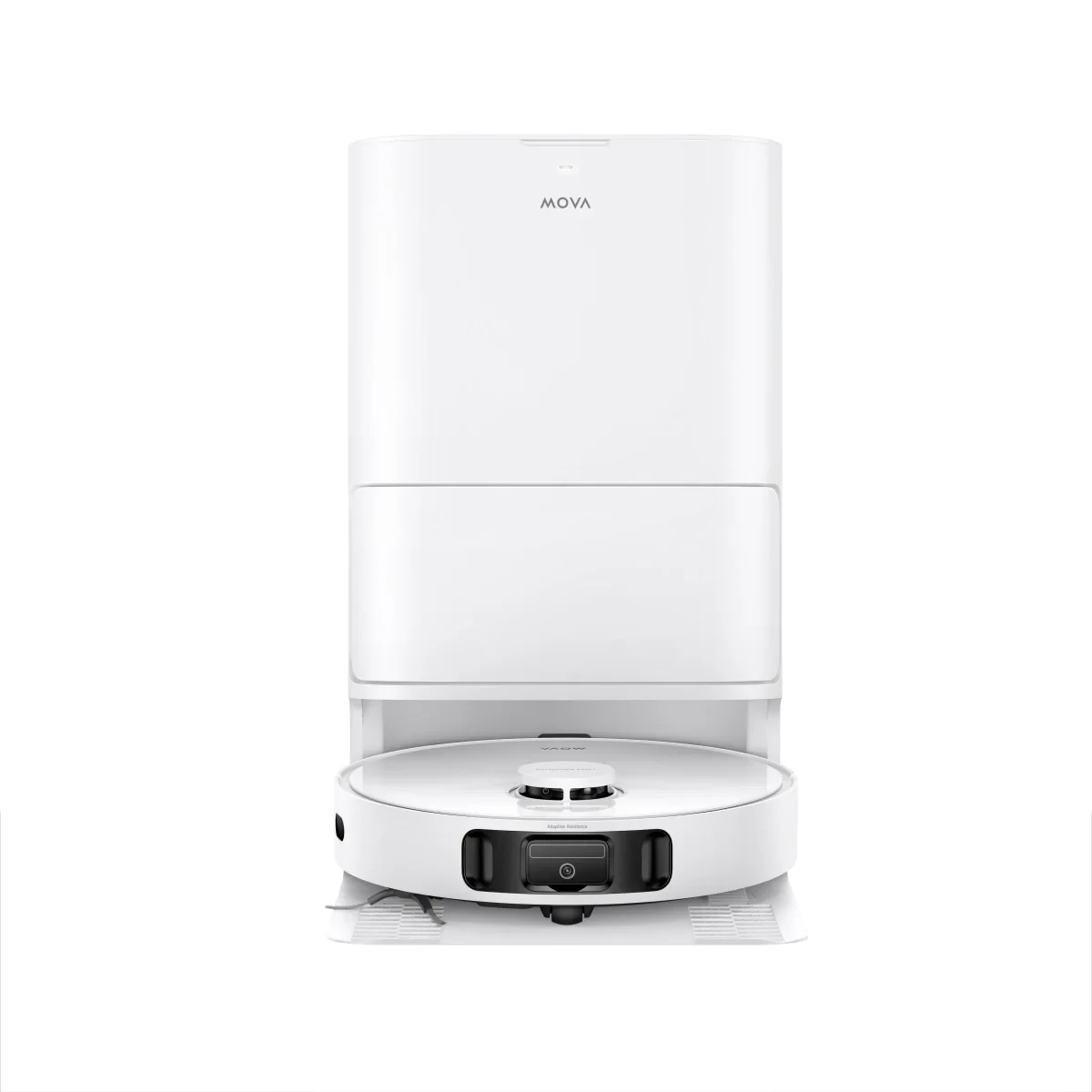
MOVA E40 Ultra
A budget full-dock robot: 19,000 Pa with a carpet boost, LiDAR with a single laser, a pad that extends 4 cm and lifts 10.5 mm, 260 minutes a charge, washing, drying, refill and 75 days of dust.
What the label leaves out
- A sensor is not a guarantee. The maker publishes which sensor the machine has, not how often it misses a cable; nobody publishes that, and we have not measured it. The groups above rank the ceiling, not the average evening.
- A camera on its own needs light to recognise anything, and some machines carry a small lamp for that; infrared structured light and depth sensors bring their own. For a robot that runs at night, the depth-sensor group is the one whose obstacle avoidance does not go off with the lights.
- Pet waste is the reason for the price. Structured light sees a lump; a camera knows to keep well away from it. With a dog or a cat at home and a robot that runs unattended, the camera groups are the ones to shortlist; the pet hair ranking weighs it together with brush and suction.
- The map is a separate score. Navigation decides coverage and speed, obstacle sensing decides what the robot survives; how we score keeps the two apart, and the LiDAR ranking answers the first question alone.
- Privacy is the flip side of a camera. A camera-based machine has a lens in your home; the makers state where the images are processed, and that statement, not the sensor, is what to read before buying.
What we would buy
For a home with a pet or with cables on the floor, the camera plus depth sensor group is the safe choice, and the Saros 20 against X60 Pro Ultra Complete comparison is the decision between the towerless Roborock and the retracting-LiDAR Dreame at the top of it. On a mid-range budget, Narwal Freo Z10 Pro against MOVA P50 Pro Ultra is structured light against a single camera at the same money. For a tidy home where the floor is cleared before the robot starts, structured light is enough, and MOVA E40 Ultra against Roborock QV 35A settles the cheapest way to get it; the best value ranking has the rest.