Robot vacuums without a camera: what the cameras see, where the pictures go, and how to buy without one
Which of the 83 robot vacuums we list carry a camera, what makers state about the images, the incidents reported so far and how to buy without a lens.
Maciej Ziółko · RoboVerdict editorial · Published · 12 min read
Two jobs for one lens: what the camera on a robot vacuum does
A robot vacuum answers two questions all the time: where am I, and what lies on the floor ahead. Our guide to how a robot vacuum sees explains the sensors that answer them; this one follows the lens, which sits in either place: three machines in our catalogue, all Narwal, navigate with cameras alone, five pair a time-of-flight sensor with a camera and one pairs a LiDAR with a camera; on the nose, 12 carry one camera, six carry two and 31 pair a camera with a depth sensor.
The makers' pages say what the lens is for: object lists from 62 types on the Roborock Qrevo MaxV to more than 300 on the Roborock Saros 20; people, pets and pet waste; a photo of the pet, which the Dreame L60 Ultra PE takes; video calls on the Qrevo MaxV. Pet recognition is a camera by another name: the seven machines that claim it all have a camera obstacle sensor, and makers name pet waste only on camera machines, so our no-camera rule counts the claim as a camera. Our scoring also ranks a plain LiDAR tower above camera-only navigation, because a camera is blind in an unlit room; Narwal's camera-navigating machines, the Flow 2 among them, carry no low-light claim.
Which of the 83 machines carry one, and which do not
By our rule, 51 of the 83 published robot vacuums carry a camera somewhere and 32 do not. The rule, read from the makers' specifications: navigation without a camera, meaning a LiDAR tower or a retracting LiDAR; obstacle sensing without a camera, meaning structured light or a bumper alone; no pet-recognition claim. The camera machines come in four kinds, camera plus depth sensor, twin cameras, a single camera and camera navigation; the Roborock S8 MaxV Ultra, the Dreame X60 Max Ultra Complete, the eufy Omni E28 and the Narwal Freo Z10 Ultra are one example of each.
One edge case: the MOVA S70 Roller and S70 Pro Roller navigate by a dToF sensor, publish no obstacle sensor, and the specification we recorded quotes no camera; our rule treats time-of-flight navigation with vision as camera navigation, so both stay out of the ranking, and we have not checked MOVA's pages for a lens. None of the 83 maker product pages we cite says where images go or whether the lens has a cover; every statement below comes from the maker pages listed at the end, read on 1 October 2026, and holds for the model it names, not the brand.
Where the pictures go: what each maker states
Roborock's Trust Center states that an obstacle photo is saved on the robot in encrypted form, that the cloud is only a temporary channel and does not store the image, that video calls are off by default and need a physical confirmation on the robot and a gesture password in the app, and that user data stays in the user's registered region. TÜV Rheinland's release of January 2024 lists four Roborock models certified to ETSI EN 303 645, a standard it describes as meant to limit cybercriminals from controlling devices, launching DDoS attacks or spying on users, and which says nothing about whether images leave the robot; two of the four are in our catalogue, the Qrevo MaxV and S8 MaxV Ultra.
Dreame writes model by model. The US page of the X60 Max Ultra Complete promises that videos and images are not uploaded to the cloud and that recognition runs exclusively on the robot, and names a UL Solutions diamond mark and TÜV SÜD; a footnote says capabilities differ by model, so the promise is that model's alone. Dreame's EU Data Act declaration for the L10s Ultra, dated December 2025, adds navigation images processed instantly and deleted, a physical button press for the remote camera, servers in Frankfurt and TÜV SÜD certification; the L10s Ultra Gen 3 we list is a different generation.
eufy names a different certifier for each model: the S1 Pro's recognition runs entirely offline, with TÜV SÜD named for ETSI EN 303 645; the X10 Pro Omni never saves the images it recognises with, certified by TÜV Rheinland; the Omni E28, the only one we list, has passed ETSI EN 303 645 with no certifier named. Narwal's Australian page for the Freo Z Ultra, which we do not list, says images are analysed on the AI chip and nothing is uploaded by default; a Narwal blog post of November 2025 says Narwal provides physical covers, naming no model; its privacy policy says it does not automatically collect photos or video without consent.
Ecovacs says it gathers images and videos for research and development only with the customer's agreement, and that the X1 and T10 families hold ETSI EN 303 645 from TÜV Rheinland and the T80, X8 and X9 families a UL Solutions Diamond level; for the DEEBOT X11 PRO OMNI, the one Ecovacs we list, we found no model-specific statement, and no Ecovacs page we read says images stay on the robot. MOVA says least: its only processing statement concerns its lawn mowers, its vacuum pages say nothing about the camera, and its privacy policy names data centres in the United States, Germany and Singapore and lists videos and photos among usage data.
What has gone wrong so far, as reported
In December 2022 MIT Technology Review reported that development Roomba J7 units, used by paid collectors and employees in five countries, had sent images to iRobot, which passed them to an annotation contractor; gig workers posted screenshots to closed social media groups. iRobot, which we do not list, said the units carried modifications never present on consumer products and ended the contractor relationship; the case shows where training images can travel.
In August 2024 the researchers Dennis Giese and Braelynn described Ecovacs robots at DEF CON 32: a PIN implemented only in the app, a static AES key, a failed fix after a 2023 report. TechCrunch reported that Ecovacs robots could be taken over by Bluetooth from more than a hundred metres away, and ABC News Australia a Deebot X2 whose camera photos were streamed to a remote server. In October 2024 ABC reported X2 units in three US cities driven remotely and shouting slurs, one owner seeing a stranger on the live feed, which Ecovacs attributed to stolen account passwords. Ecovacs' advisory of 19 November 2024 acknowledged a Bluetooth remote code execution flaw and listed patched firmware for X2, X5 and T30 models.
In August 2025 ABC reported a misconfigured certificate check in the Dreame app, found by Giese, that let credentials and session tokens be intercepted on hostile Wi-Fi; the report does not establish that camera footage was exposed. In September 2025 two Korean agencies, KISA and the Korea Consumer Agency, reported three of four Chinese models surveyed vulnerable, including photo leakage on two models and remote camera activation on the Dreame X50 Ultra, as the Korea JoongAng Daily and the Korea Herald reported; per the Korea Herald, all affected companies had patched the issues. For 2026 we found nothing new beyond Ecovacs' Privacy Shield, a physical camera cover announced in September 2026 for the DEEBOT X12S, which we do not list. The lesson: account passwords and firmware updates decided these cases as much as the sensor did.
What EU law says, in plain words (not legal advice)
This section describes EU rules only, says nothing about US law and is not legal advice. The General Data Protection Regulation has applied since 25 May 2018. Under Article 4(1) an image in which a person can be identified is personal data; Article 2(1) covers processing by automated means, which is where a company handling such images falls; the household exemption in Article 2(2)(c) concerns the private individual, not the manufacturer. The text mentions neither robot vacuums nor cameras. The European Data Protection Board's guidelines 3/2019 on video devices, in the version adopted in January 2020 and written for surveillance cameras, add that people are identifiable by their looks and that the household exemption must be narrowly construed, although a device inside a private home may fall under it.
The Cyber Resilience Act, Regulation (EU) 2024/2847 of 23 October 2024, sets rules for products with digital elements. It applies from 11 December 2027; the manufacturers' reporting obligations in Article 14 apply from 11 September 2026 and the chapter on conformity assessment bodies from 11 June 2026. It does not name robot vacuums.
How to buy without a camera
You give up recognition: structured light steers round a lump without knowing what it is, and our cons on the Roborock Qrevo Curv S5X and Narwal Freo X10 Pro say so. You keep more than the label suggests: all 32 no-camera machines map with a LiDAR tower, which works in the dark, 25 add structured light on the nose and seven rely on the bumper alone. Docks are not the trade-off: 23 of the 32 have a dock that empties the bin and washes the mop, and the group spans Dreame with 12 machines, Roborock with 10, MOVA with 8, Narwal with 2 and eufy with 1.
By list price in our catalogue, tier by tier rather than as one ordered list: the Roborock Q7 M5 and Q10 X5, the Dreame D20 Air Plus and the Roborock Q10 S5+ open the group; the middle holds the MOVA E40 Ultra, Roborock QV 35A, Narwal Freo X10 Pro and Narwal Freo Z10 Pro, each with a dock that empties and washes; the upper tier has the Dreame L40 Ultra Gen 2, D30 Ultra, Roborock Qrevo Curv S5X, Qrevo 2 Pro and eufy Omni C28; the Dreame Aqua10 Roller AE closes the group with a roller mop. The Dreame L60 Ultra FE shows that a top-tier machine can still have no obstacle sensor at all.

Narwal Freo Z10 Pro
Narwal's budget robot: 18,500 Pa, Reuleaux mops at 12 N that swing to edges and lift 12 mm, LiDAR with two structured-light sensors, and a dock that washes, dries and doses detergent.
The ranking of robot vacuums without a camera shows ten of the 32, weighted towards cleaning and navigation. On 1 October 2026 its top three were the Dreame Aqua10 Roller AE, the Dreame L40 Ultra Gen 2 and the Narwal Freo Z10 Pro; the order moves as products change, and the ranking page carries the shop links.
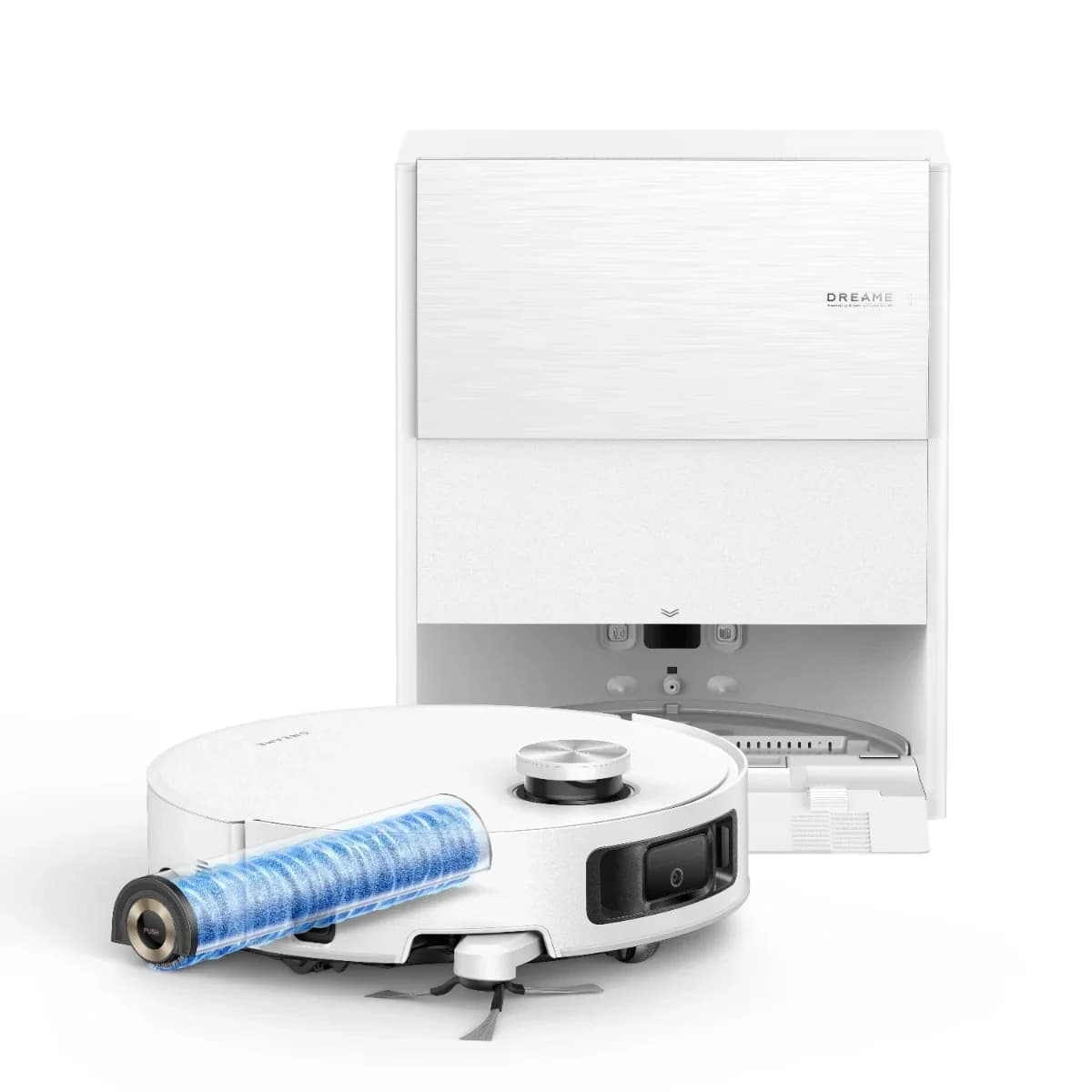
Dreame Aqua10 Roller AE
The American Aqua10 Roller: 30,000 Pa, a fresh-water roller mop that extends 4 cm, lifts 14 mm and seals itself on carpet, 4 cm double thresholds, four maps, a 100 °C wash and 65 °C drying.
If you accept a camera: what to read before you buy
Read the statement for the exact model, not the brand; Dreame's footnote and eufy's three certification lines show why. From what the makers above state, a statement worth having contains:
- Where the image lives: encrypted on the robot, or deleted once used, and nothing uploaded by default.
- Remote video off by default, with a physical confirmation on the robot and a PIN or gesture password in the app.
- A named standard and certifier for the model you are buying; a certificate says nothing about where images go.
- A named data-centre region.
- A physical cover: only the Ecovacs X12S, which we do not list, states one; Narwal mentions covers without a model; no machine in our catalogue has a stated lens cover.
- Account hygiene and updates: the hijacked X2 units were attributed to stolen passwords, the Bluetooth flaw was closed by firmware, and a maker that publishes advisories with a model list gives you something to check.
Where to go next: the obstacle avoidance ranking orders every machine with a camera obstacle sensor, weighted on recognition, and the pet hair ranking admits the same group with the weight on cleaning. How we score sets out how navigation and obstacle sensing are credited.
Sources, all read on 1 October 2026: Roborock's Trust Center and TÜV Rheinland's release of 10 January 2024; Dreame's X60 Max Ultra Complete page, undated blog post on robot vacuums with a camera and EU Data Act declaration for the L10s Ultra, a Dreame document hosted on Amazon's product-document servers; eufy's pages for the S1 Pro, X10 Pro Omni and Omni E28; Narwal's Australian Freo Z Ultra page, blog post of 6 November 2025 and privacy policy; Ecovacs' blog post of 14 August 2023, newsroom note of 1 June 2025, security advisory of 19 November 2024 and X12S press release of 4 September 2026; MOVA's lawn mower FAQ, US privacy policy and global privacy policy; MIT Technology Review's report of 19 December 2022; the DEF CON 32 slides, TechCrunch of 9 August 2024 and ABC News Australia of 4 October 2024, 11 October 2024 and 17 August 2025; the Korea JoongAng Daily of 2 September 2025 and the Korea Herald of 3 September 2025; and, on EUR-Lex, the GDPR and the Cyber Resilience Act, with the EDPB's guidelines 3/2019 on video devices. The sensor counts are the makers' specifications in our catalogue of 83 robot vacuums on the same day.