Robot vacuums and pet hair: suction is the wrong number to shop by
What decides whether a robot vacuum copes with a dog or a cat, from the specifications of 83 machines: the brush, what the robot sees, where the hair goes, and two figures almost nobody publishes.
Maciej Ziółko · RoboVerdict editorial · Published · 5 min read
The number on the box
Every robot vacuum is sold by its suction: 8,000 Pa two years ago, 20,000 last year, 42,000 on this year's flagships. For a home with a dog or a cat it is the least useful figure on the page. Hair is not heavy; it does not need lifting so much as catching, and what catches it is the brush. A machine with four times the suction and the wrong roller wraps the first long hair around its bearings and spends the week pushing a felt rope across the floor. Below is what actually separates the 83 robot vacuums in our catalogue for a home with animals, from the makers' own specifications, in the order it matters.
1. The brush, because hair wraps
A bristle roller collects hair the way a hairbrush does, and someone has to cut it out with scissors. Rubber fins shed hair better, and the current designs go further: two counter-rotating rollers, a comb that strips the roller as it turns, or a blade that cuts a hair before it winds. We record those as anti-tangle, and 68 of the 83 machines now have one, the biggest change in this category in three years. Eleven still use a single rubber roller, among them the Roborock Qrevo MaxV, the Dreame X40 Master, the Dreame L10s Ultra Gen 3, the MOVA P70 Pro Ultra and the MOVA E40 Ultra; two use twin rubber rollers, the Roborock S8 MaxV Ultra and the MOVA S20 Ultra. Only two ship with bristles, the MOVA E50 Pro Ultra and the E50 Ultra, and MOVA sells the anti-tangle brush for them separately. With a long-haired animal this is the line of the specification to read first, and on several Dreame and MOVA models the hair-cutting brush is an accessory rather than the brush in the box.
2. What the robot sees, because of what a pet leaves
The second thing a dog leaves on a floor is the one a robot must not drive through. Ten of the 83 machines have no obstacle sensor at all, and twenty-four use structured light, which sees a lump a few centimetres high and steers around it without knowing what it is. Forty-nine carry a camera with object recognition, alone, in pairs or with a depth sensor, and those are the ones whose makers name pet waste, cables and socks. Our pet hair ranking admits only that group for that reason, and how a robot vacuum sees describes each sensor and names the models.
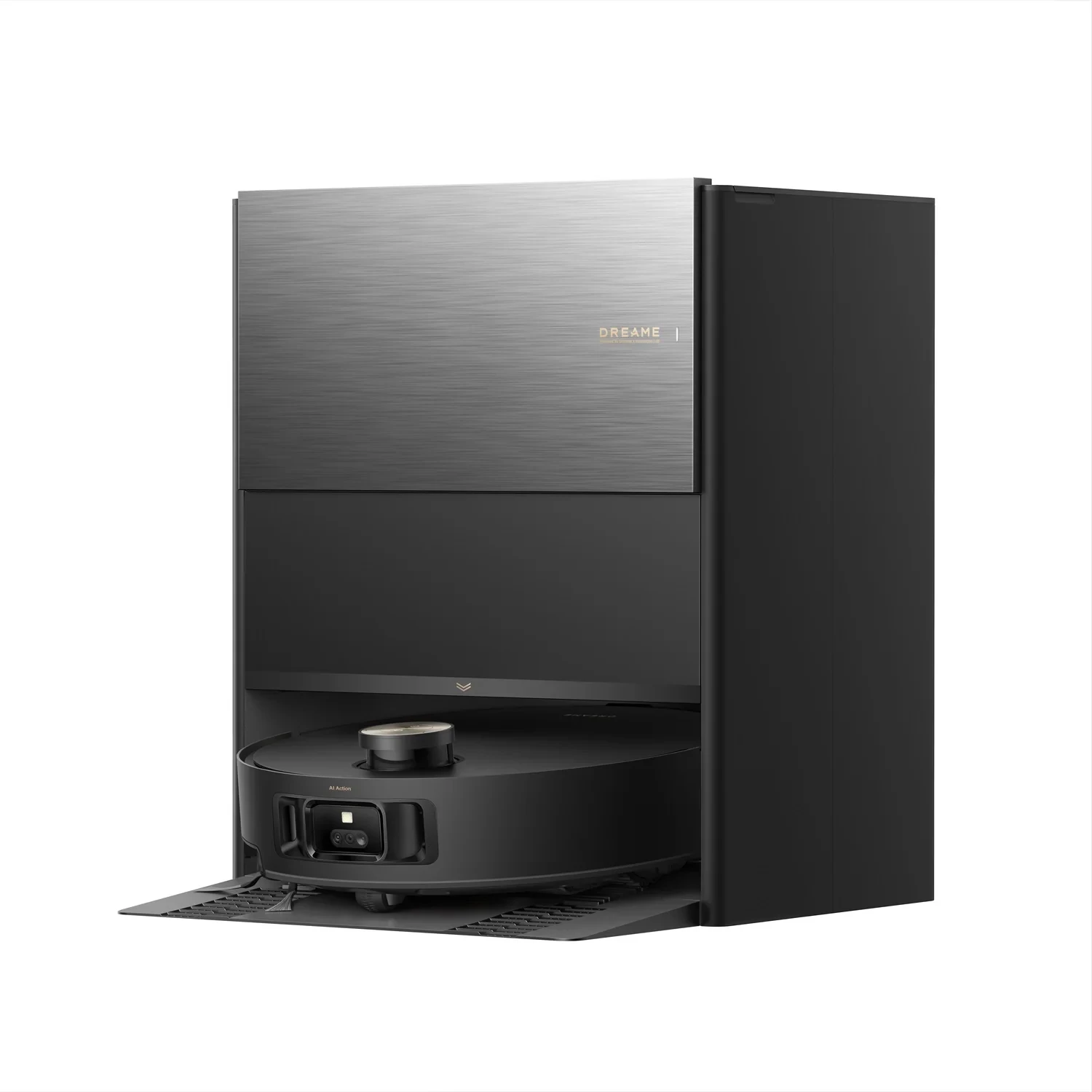
Dreame Aqua10 Roller
Roller mop and legs without the retracting turret: 30,000 Pa with a carpet boost, a roller at 9 to 11 N that lifts 14 mm under a guard, a 4.2 cm sill or 6 cm double step, 120 mm tall, a 100 °C wash.
3. Whether it knows an animal when it meets one
Recognising a sock is not recognising a cat. Only seven of the 83 machines publish that they identify pets: the Roborock S8 MaxV Ultra and Qrevo MaxV, the Dreame X60 Max Ultra Complete, L60 Ultra PE, L50 Pro Ultra and L40s Pro Ultra, and the MOVA V70 Ultra Complete X. What they do with it differs by maker: the Qrevo MaxV stops its brush and moves aside, while the Dreame L50 Pro Ultra and L40s Pro Ultra keep away from bowls and litter boxes, come back later for the spot the animal was lying on and will go looking for the pet on request. None of it cleans better. It decides whether a nervous animal and a robot can share a flat while nobody is home.
4. Where the hair goes
Seventy-eight of the 83 machines empty themselves into a bag in the dock, so the small bin on the robot stops mattering; the five that do not are the Roborock Q7 M5 and Q10 X5, the Dreame L10s Pro Gen 3 and D20 Pro and the MOVA S10, and with a shedding animal that means emptying the bin by hand, often daily while the coat is changing. The bag is rated in days: 100 is the common figure, Narwal and the MOVA Z70 Ultra Roller Complete claim 120 to 125, and the Roborock docks that publish one say seven weeks. Those are the makers' estimates for an ordinary household, and none publishes a figure for a home with a dog, so read them as a ceiling. The self-emptying ranking weighs the dock, and the dock guide explains what each of its jobs is worth.
5. The two figures almost nobody publishes
Noise is what every owner of a nervous animal asks about, and three of the 83 machines answer: the Narwal Flow 2 at 57 dB and the Roborock Saros 20 Sonic and Qrevo 2 Pro at 63 dB. Everyone else publishes nothing, so a quiet robot cannot be chosen from a specification sheet, and our pages say "not published" rather than guess. The bin on the robot is the other one: 23 machines state it, from 210 to 470 ml, and it only matters on the five machines without a self-emptying dock.
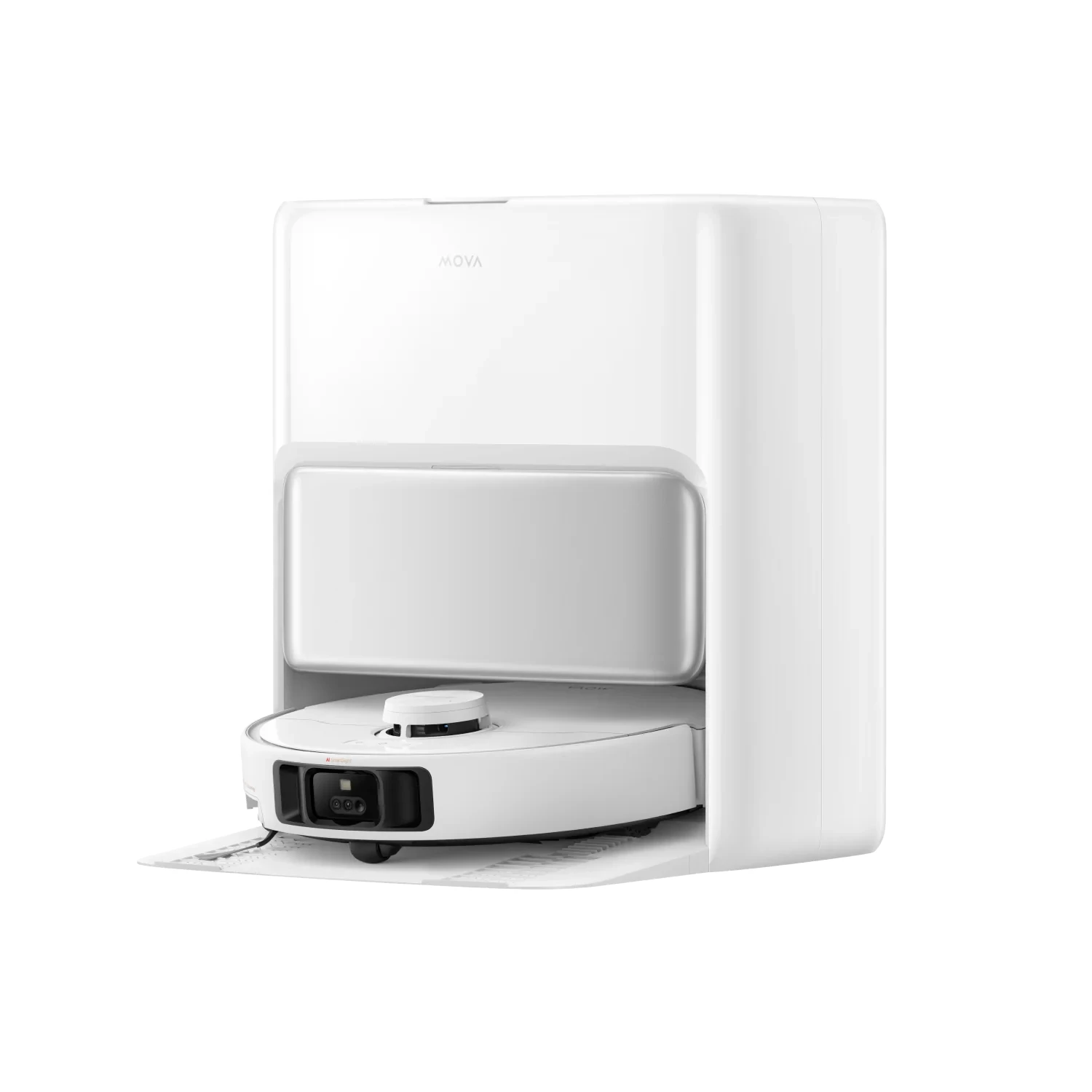
MOVA P50 Pro Ultra
A pad mop with a camera: 19,000 Pa, anti-tangle brushes, pads that swing 4 cm and detach for carpet, a 75 °C wash with drying, refill and detergent, 75 days of dust and third-party voice control.
What we would buy
With a long-haired animal and a free choice, take an anti-tangle brush and a camera with a depth sensor. The Dreame Aqua10 Roller pairs the two and, as this is written, sits second in the pet hair ranking behind the America-only L60 Pro Ultra. On a tighter budget the MOVA P50 Pro Ultra is, as this is written, the cheapest machine in our European price records with a camera and an anti-tangle brush, and Narwal Freo Z10 Pro against MOVA P50 Pro Ultra is exactly the question of whether the camera is worth paying for. If the animal is nervous, shortlist the seven that recognise pets and check the where-to-buy card for your country, because two of them are sold by their makers in America only. And if the home is mostly rugs, read the carpet ranking as well: that is the one place where the suction figure earns its position.