Robot vacuum docks explained: self-emptying, mop washing, drying, refill and plumbing
The five jobs a robot vacuum dock can do, which machines we list do which, what the dust-bag interval means and which dock you actually need.
Maciej Ziółko · RoboVerdict editorial · Published · Updated October 25, 2026 · 5 min read
Five jobs a dock can do
The dock is where a robot vacuum stopped being a gadget and became an appliance, and it is now most of the price. A dock can do up to five things. It can empty the robot's bin into a bag, so you touch dust once a month or two instead of every run. It can wash the mop pads or roller. It can dry them with warm air afterwards, which is the step that stops a damp mop smelling. It can refill the robot's clean-water tank from its own. And on three machines we list it can be plumbed into the water supply and drain, so the tanks disappear entirely.
What the catalogue shows
Of the 114 robot vacuums we list, 74 have a dock that does all four of the everyday jobs: empty, wash, dry and refill. The Dreame X60 Pro Master, X50 Master and X40 Master are the three with a plumbed dock on top of that. Thirteen machines empty, wash and dry but do not refill the water tank, which on all but one means filling the robot's own small tank by hand: the Roborock Qrevo Curv 2 Pro, Saros Z70, Saros 20 Sonic, Qrevo Curv 2 Flow, Qrevo Curv S5X, Qrevo 2 Pro and Qrevo S5V, the Narwal Freo Z10 Turbo and Freo 20 Edge, the Dreame D30 Ultra, the MOVA E30 Ultra, the Ecovacs DEEBOT T90 PRO OMNI and the eufy Omni C30. The Omni C30 has no tank on the robot at all, and eufy lets it return mid-run to rinse its pads more often.
Six machines wash and refill but do not dry the mop: the MOVA Mobius 60, Roborock Saros 20 Neo, Roborock Saros 20 Flow, Roborock Qrevo Edge 3 Pro, Dreame X60 Ultra and Narwal Flow. Two only empty and wash, the Roborock Qrevo Edge 2 and Saros 10. Ten only empty: the Roborock Q10 S5+, Q10 X5+, Q7 L5+ and Q7 M5+, the Dreame D20 Air Plus, D20 Plus, D20 Pro Plus and D10 Plus Gen 2, the MOVA S10 Plus and the Narwal Freo S. And nine come with a charger and nothing else.
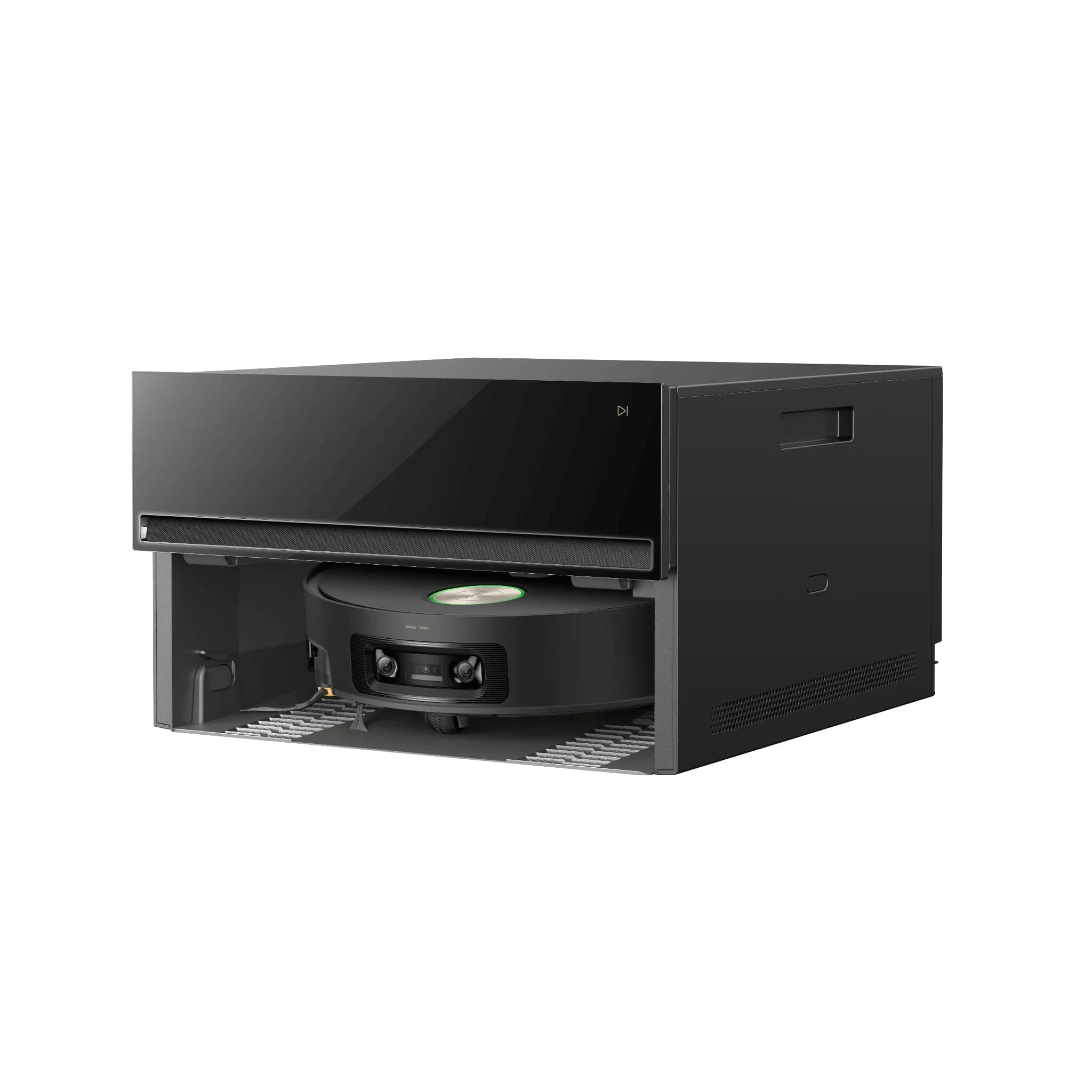
Dreame X60 Pro Master
The X60 Pro with a plumbed dock only 249 mm tall: the same 42,000 Pa, 89 mm clearance, climbing legs and 18 cm mop reach, with water piped in and out instead of carried in tanks.
The dust-bag interval
Makers state how long a bag lasts in days, at a usage they assume and do not always state, so the figure compares makers with themselves better than with each other. Roborock publishes 49 days for the Qrevo CurvX, Qrevo Curv S5X, Qrevo MaxV, S8 MaxV Ultra, Q10 S5+, Q10 X5+, Q7 L5+ and Q7 M5+, and 65 for the Qrevo Edge 2 Flow; for its other docks it publishes no figure. MOVA publishes 75 days on the P50, E30, E40 and S20 lines, 90 on the S10 Plus and 100 on the Z60, V50, V70, S70 and E50 lines, with no figure for the P70 Pro Ultra, the Mobius 60, the V70 Ultra Complete X or the V70 Ultra Pure. Dreame publishes 100 days across most of its range, 75 on the X40 Ultra and L10s Ultra Gen 2, 90 on the D10 Plus Gen 2, 120 on the D20 Air Plus and 150 on the D20 Plus and D20 Pro Plus. Narwal publishes 120 days on every dock it lists except two: the Freo Z10 Turbo, for which it gives no figure, and the Freo S, at 180 days the longest in our catalogue. The MOVA Z70 Ultra Roller Complete publishes 125.
What the spec sheet does not tell you
- How loud emptying is. Most makers in our catalogue publish no figure for it, and it is the loudest thing the machine does.
- Detergent. Several docks dispense a cleaning solution; we do not yet record which, so a product page's silence on it is our gap, not the maker's.
- Wash-water temperature. Hot-water washing is now a selling point, and we now record the figure wherever a maker publishes one. It is the claim for the dock's heater, not a temperature measured at the pad, and a dock that promises hot water without a number has none recorded. The hot-water mop washing ranking orders the docks by it.
- The dock's size. A dock that washes and dries is a box the size of a small bin, and it wants a wall socket and, ideally, a hard floor under it. Measure the spot before you order.
Which dock you need
If the robot mops every day, the dock must wash and dry; a mop that is washed and left wet is worse than one that is not washed. With rugs on the floor, the dock is also where some robots leave their mops before a carpet run, and what a mopping robot does at the edge of a rug compares that with lifting the mop. Refill matters when the robot's own tank empties mid-run in a larger home; the large-homes ranking is where that shows. With a pet, the bag interval and the bin emptying are what save you from the dust, and the self-emptying ranking weights them. In a one-bedroom flat with hard floors and no pet, a dock that only empties, or none at all, is a defensible saving, and the best value ranking includes several. How we score sets out how each of the five jobs is credited in the automation subscore.
More articles
- Robot vacuums that mop, and your rugs: lift the mop, leave it at the dock, or steer round the carpet
16 min read
- Robot vacuums without a camera: what the cameras see, where the pictures go, and how to buy without one
12 min read
- Black Friday 2026 robot vacuums: how to tell a real discount from a permanent one
6 min read