Which robot mower for which lawn size? What the rated area means, from 250 to 5,000 m²
How to measure a lawn, what a maker's rated area means, how much margin to leave, and which robot mowers we list suit a small, a medium or a large garden.
Maciej Ziółko · RoboVerdict editorial · Published · 6 min read
Short answer: measure, add a quarter, then choose
Measure the grass, add a quarter, and choose a mower whose maker rates it for at least that area. Of the 52 robot mowers we list, the smallest rating is 250 m² and the largest 5,000 m². For a lawn of up to 800 m², that points to the small-lawn ranking, which keeps to machines rated for 1,000 m² or less; from 1,600 m², to the large-lawn ranking, which starts at 2,000 m². In between, the Robot Finder asks for the size and keeps only the machines rated for it.
Measure the lawn first
Only grass counts. Split the lawn into rectangles and triangles, measure each with a tape and add them up: length times width for a rectangle, half the base times the height for a triangle. Leave out beds, paths, the terrace and the pond. If the mower is to look after a front lawn and a back lawn, add both: the zones share one machine and its hours. Write down the narrowest passage between them as well, because the mower has to fit through it.
What the figure on the box means
The area on a spec sheet is the maker's maximum: the largest lawn the machine is meant for, not the size it gets through most easily. Of the 52 mowers we list, 10 also carry a recommended area. For seven Segway Navimow models it is the same figure as the maximum. Only three recommend less than their maximum: Mammotion recommends 1,200 of the YUKA 1500's 1,500 m² and 4,000 of the LUBA 2 AWD 5000's 5,000 m², and eufy 600 of the E15's 800 m². That is 80 percent of the maximum for the two Mammotion models and 75 percent for the eufy.
Our rule follows that proportion: add a quarter to the area you measured and look for a rating at least that large. A lawn of 800 m² wants a mower rated for 1,000 m², one of 1,600 m² a mower rated for 2,000 m². We leave the margin because a garden with beds, trees and narrow strips takes longer to mow than open grass of the same size.
Square metres are not hours
The rated area does not say how long one full pass takes. Segway publishes that time for five Navimow models: the i220 LiDAR needs 18.5 hours for its 2,000 m², the X420 8 hours for the same 2,000 m². Width and pace make the difference: the X420 cuts 430 mm wide and Segway rates it at 450 m² an hour, while the i220 LiDAR cuts 220 mm at 160 m² an hour. The i208 LiDAR needs 9 hours for its 800 m², the i215 LiDAR 16 hours for 1,500 m² and the X450 15 hours for 5,000 m².
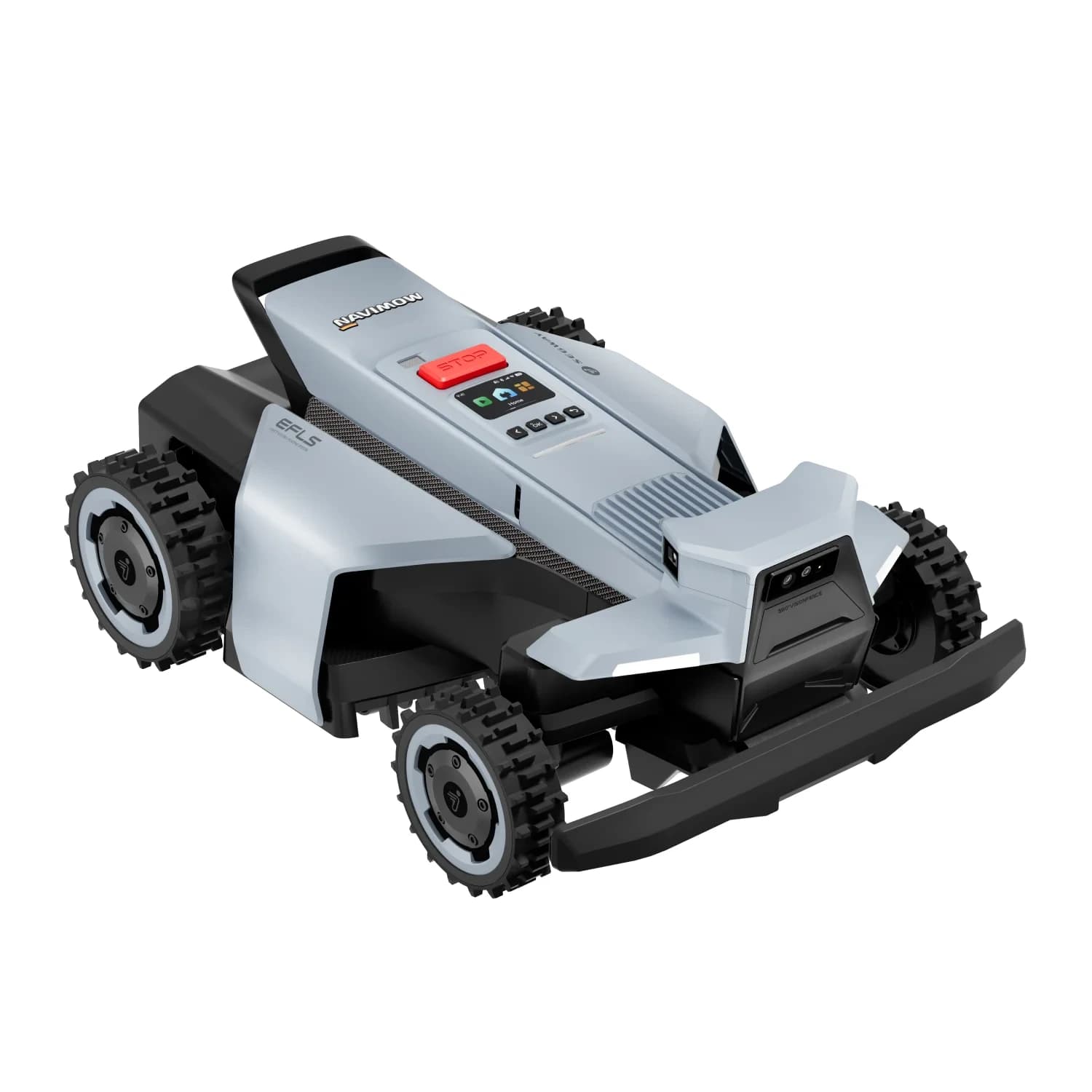
Segway Navimow X420
Segway's large-lawn flagship for 2,000 m²: four-wheel drive with dual suspension for 84% slopes, a 43 cm twin-disc deck with two 180 W motors, network RTK with a 360° camera and 120 zones.
If the mower may work only in daylight, those hours spread over more than one day: a full pass of 2,000 m² takes the i220 LiDAR at least two. Dreame states 5,000 m² in 24 hours for the A3 AWD Pro 5000, so its maximum counts the night as well as the day. Where a maker publishes no time, divide your area by the hourly rate on the product page, where there is one, and set the result against the hours you will let the mower run.
What the catalogue offers at each size
The 52 mowers we list spread over the sizes like this: 7 are rated for up to 500 m², 19 for 501 to 1,000 m², 16 for 1,001 to 2,000 m² and 10 for 2,001 to 5,000 m². None is rated for more than 5,000 m².
Up to 500 m²
The seven smallest are the MOVA ViAX 250 at 250 m², the ViAX 300 at 300 m² and five at 500 m²: Anthbot's M5, M5 LiDAR and M5 PRO, and Segway's Navimow i105E and i205 AWD. With the margin they suit a lawn of up to 400 m², the ViAX 250 one of up to 200 m² and the ViAX 300 one of up to 240 m².
501 to 1,000 m²
The largest group, with 19 machines, and the one where everything but the size decides: positioning, slopes and trees. With the margin, a lawn of 401 to 800 m² lands here. Of the 52 mowers, 26 are rated for 1,000 m² or less, and the small-lawn ranking puts the best of them in order.
1,001 to 2,000 m²
This group holds 16 machines, and with the margin a lawn of 801 to 1,600 m² lands in it. Neither ranking by size covers all of it, because the large-lawn ranking starts at 2,000 m². The Robot Finder asks for the size in steps from 500 to 5,000 m² and keeps only the machines rated for the step you choose, and all robot mowers lists the whole catalogue.
2,001 to 5,000 m²
This group holds 10 machines, and from this size on the cutting width counts as much as the rating. Of the 15 mowers rated for 2,000 m² or more, 9 cut 400 mm wide or wider; of the 26 rated for 1,000 m² or less, only the MOVA LiDAX Ultra 1000 AWD does. A wider cut means fewer passes over the same grass, which is how the X420 covers its 2,000 m² in less than half the i220 LiDAR's hours. The large-lawn ranking, which starts at 2,000 m², puts the best of them in order.
Above 4,000 m²
With the margin, a lawn of more than 4,000 m² goes beyond every rating in our catalogue. Four machines reach 5,000 m²: the Dreame A3 AWD Pro 5000, Mammotion's LUBA 2 AWD 5000 and LUBA 3 AWD 5000, and the Segway Navimow X450. For these the arithmetic of hours decides: the X450 needs 15 hours for its 5,000 m², and Mammotion recommends 4,000 m² for the LUBA 2 AWD 5000. For more than 5,000 m², plan two machines, each with its own part of the lawn.
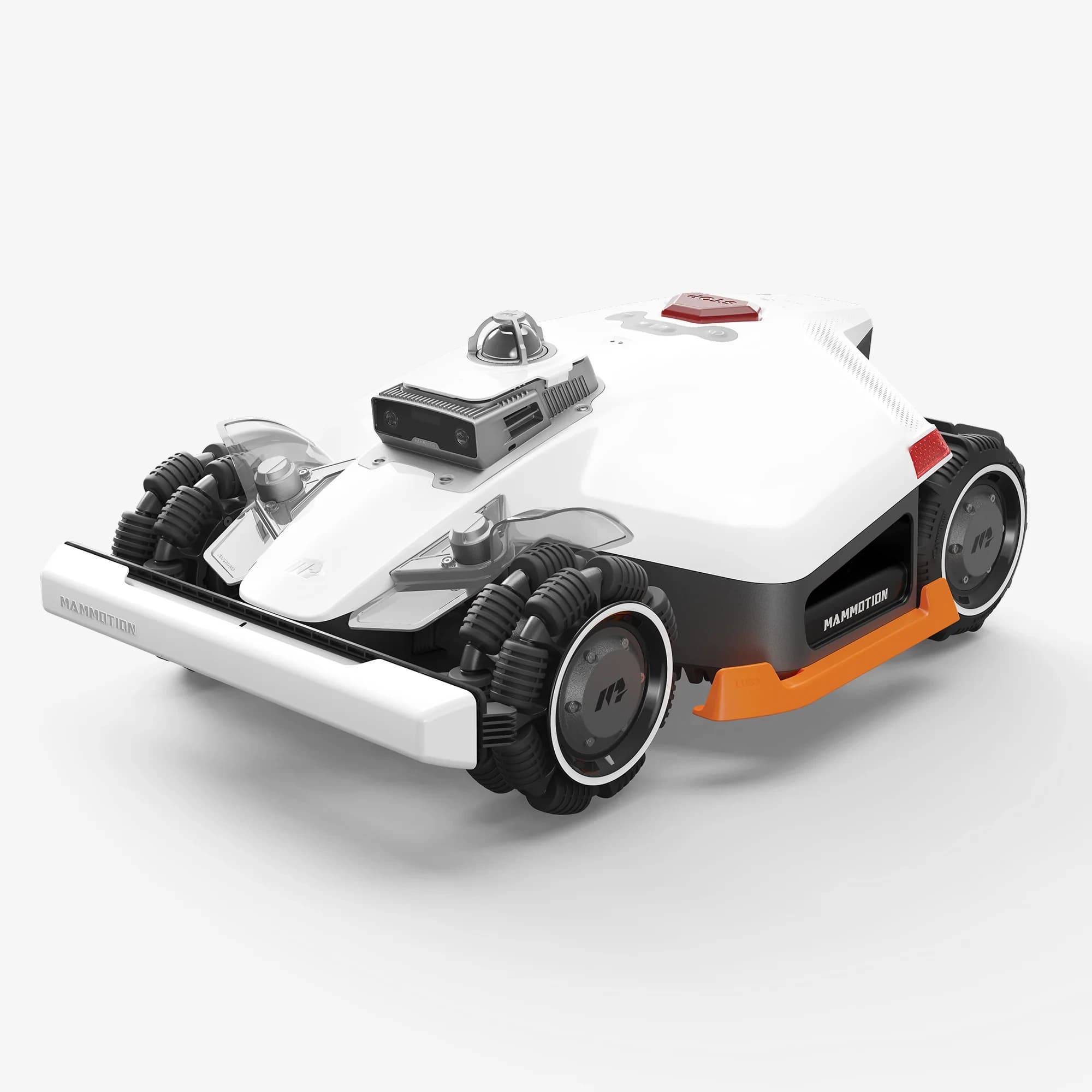
Mammotion LUBA 3 AWD 5000
All-wheel-drive flagship for 80% slopes and 5,000 m², positioned by 360° LiDAR, network RTK and two cameras together, with no reference antenna to site.
Where to go from here
Size narrows the list; it does not choose the machine. Trees and buildings decide which positioning system works, as robot mowers without a boundary wire explains, and banks decide the drive, as what 45%, 55% and 80% really mean shows. The small-lawn ranking, the large-lawn ranking and the Robot Finder do the rest.
A note on what these numbers are
Every figure in this article is the maker's published specification as our catalogue holds it, cited on the product page it links to; how we score sets out the arithmetic behind the scores. Nothing here comes from our own trials of the machines, and the margin and the arithmetic of hours are ours, not a maker's.