Robot mower without a boundary wire: RTK, LiDAR or cameras?
How the three wire-free positioning systems work, where each one fails, and which to choose for an open lawn, a tree-covered garden or a steep one.
Maciej Ziółko · RoboVerdict editorial · Published · Updated October 21, 2026 · 6 min read
Why the wire went away
For fifteen years a robot mower knew where the lawn ended because someone had buried a wire around it. That worked, and it is why an Automower from 2012 still runs. It also meant a day on your knees with a spool and pegs, a lawn shape that was fixed the moment the wire went in, and a fault every time a spade, an aerator or a mole cut it. Every serious machine launched since 2023 positions itself instead, and by 2026 the wire is a budget-category feature. The question is no longer wire or no wire. It is which positioning system suits your garden, because the three on sale fail in different places.
RTK: satellites, with a catch
RTK-GNSS takes the ordinary satellite fix a phone gets, accurate to a few metres, and corrects it to a couple of centimetres against a second receiver at a known point. The first generation put that receiver on a mast in your garden: the LUBA 2 AWD and the Navimow H-series needed clear sky at the antenna and at the mower, a mounting point and power. Under a tree canopy or between the house and the fence, the fix drops and the machine stops.
The second generation removes the mast. Mammotion's NetRTK and Segway's Network RTK take the correction from a reference-station network over a built-in 4G link, so the LUBA mini 2 AWD and the Navimow i205 AWD install with nothing to site. What has not changed is that the mower itself still needs to see the sky. RTK is the right answer for an open lawn and the wrong one for a garden under mature trees.
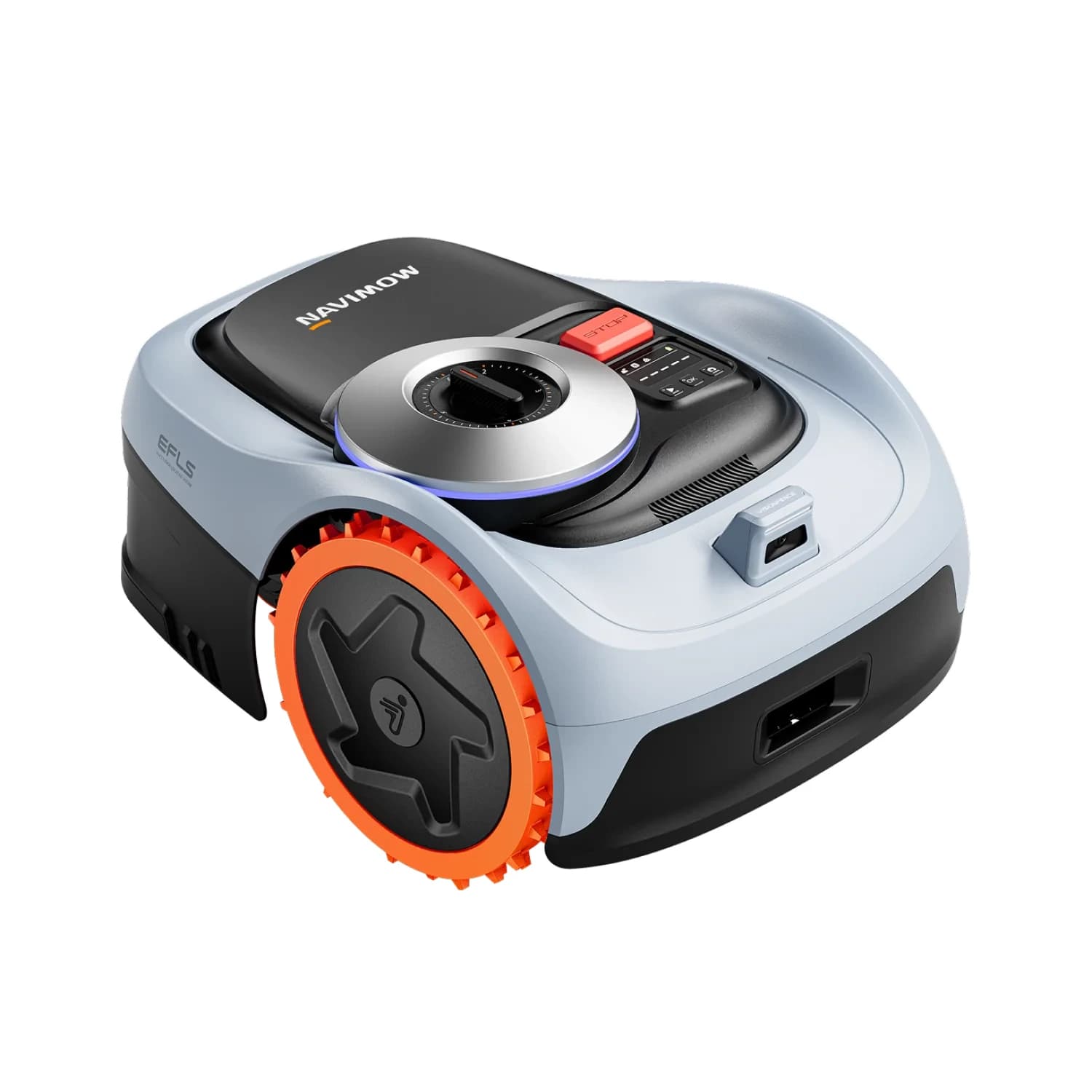
Segway Navimow i205 AWD
Segway's entry wire-free mower for 500 m²: network RTK and a 140° camera with no antenna to site, three driven wheels, a 45% slope rating and an 18 cm cut.
Which mowers need an RTK antenna
Of the 52 mowers in our catalogue, 21 position by RTK. Nine of them still need the reference antenna on a mast with clear sky: the Ecovacs GOAT O800 RTK, the Mammotion LUBA 2 AWD, the YUKA 1500, the Anthbot Genie 600e, Genie 800, Genie 1000, Genie 3000 and N8, and the Navimow i105E. Twelve take the correction from the network and install without one: the LUBA 3 AWD in its 3000 and 5000 versions, the LUBA mini 2 AWD, the YUKA mini 2 800, the Navimow i205 AWD, i210 LiDAR Pro, X420 and X450, and the Anthbot M5, M5 Pro, M9 and M9 Pro. The other 31 machines do not use satellites at all: 23 position by LiDAR with a camera, three by LiDAR alone and five by camera alone. The RTK ranking lists the satellite machines by score, the LiDAR ranking the laser ones.
LiDAR: a map of what it can see
A LiDAR mower spins a laser and builds a map from the walls, hedges, trees and furniture around it, the same technique a robot vacuum uses indoors. It needs no satellite and no antenna, it works at dusk and under trees, and it maps itself on the first run. Its weakness is the mirror image of RTK's: a featureless open field gives the laser nothing to hold on to, and a garden that changes, whether by a parked trailer or a moved trampoline, changes the map. Dreame's A3 AWD and A3 AWD Pro position by LiDAR alone, with cameras to recognise what the laser sees; Mammotion's YUKA mini 2 is the cheapest machine of the kind in our catalogue.
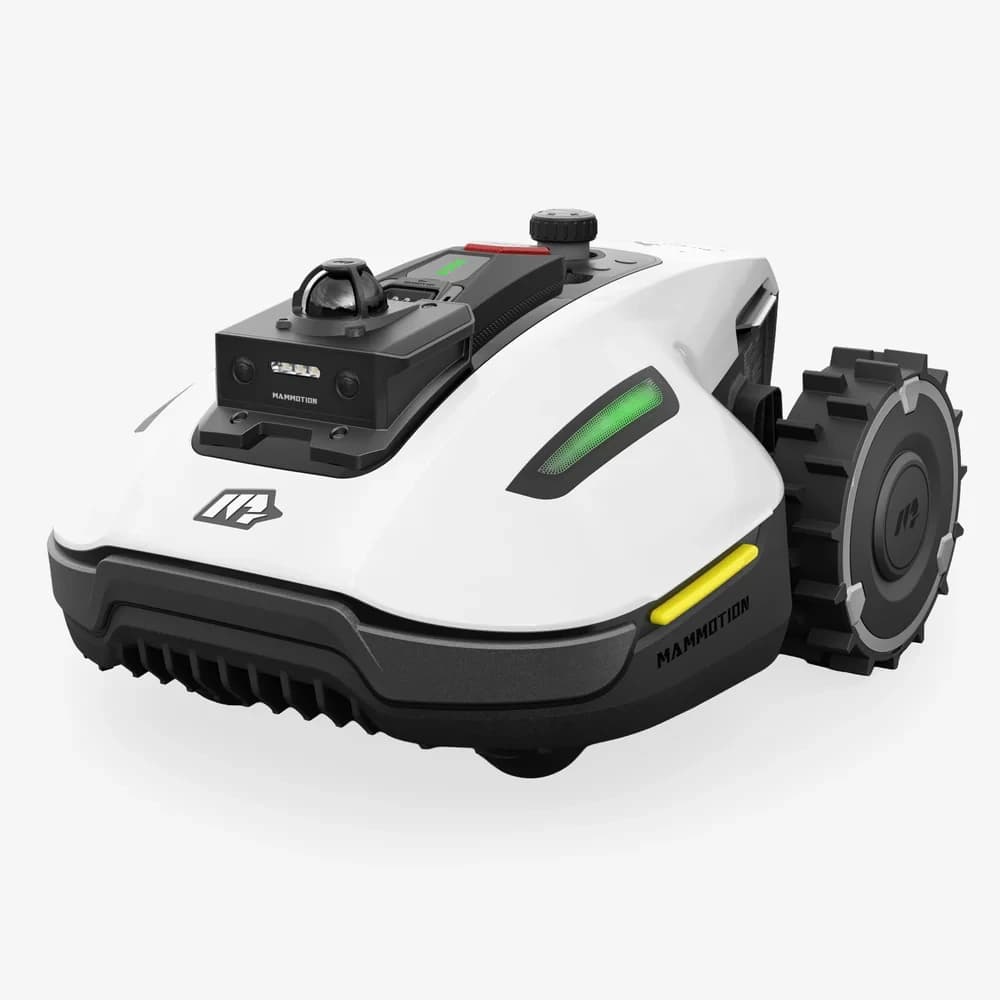
Mammotion YUKA mini 2 1000
Small-lawn mower for 1,000 m² that maps with a 360° LiDAR and two cameras, with no wire, antenna or satellite to set up, on rear-wheel drive rated for 45% slopes.
Cameras: recognition, rarely positioning alone
Every current machine carries a camera, but for two different jobs. Obstacle recognition (a hedgehog, a hose, a child's shoe) is a camera job on all of them. Positioning by camera alone is rarer: eufy's E15 does it, which is why it wants a garden with visual structure and daylight. On most machines the camera is the third leg: it corrects RTK drift under a tree, and it tells a LiDAR map what the shapes are.
Fusion: the answer for a difficult garden
The flagships now run all three. Mammotion's LUBA 3 AWD and Segway's Navimow i210 LiDAR Pro fuse LiDAR, network RTK and a camera, so the machine holds its position where any one system would lose it. That is what the flagship price buys: not a wider deck, but a mower that does not stop when the fix does.
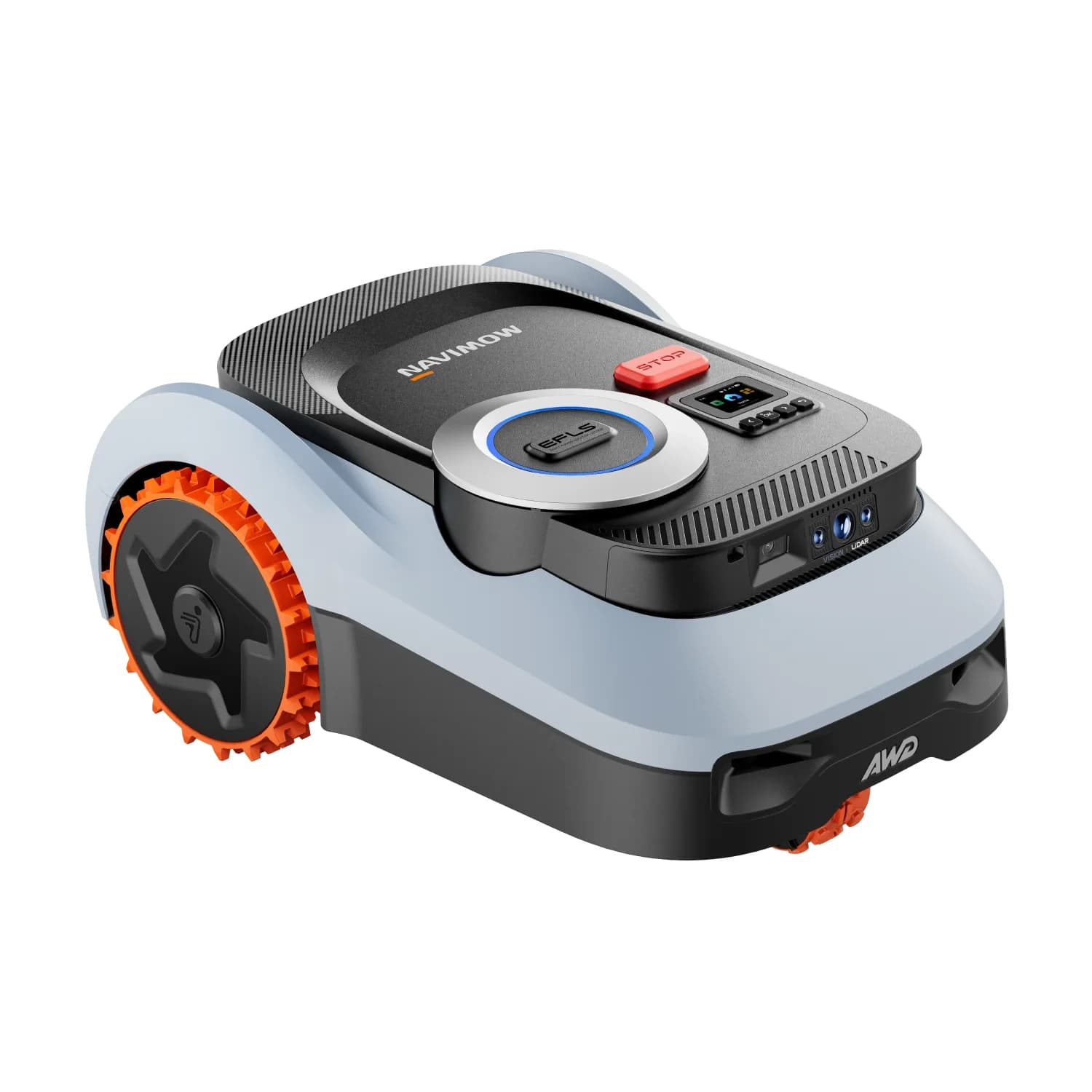
Segway Navimow i210 LiDAR Pro
Segway's tri-fusion mower for 1,000 m²: LiDAR, network RTK and a camera together, a 22 cm six-blade disc, EdgeSense edge mowing and a 55% slope rating on three driven wheels.
What to check in your own garden
- Sky. Stand where the mower will work and look up. If more than a third of the sky is tree canopy, RTK alone will struggle; look at LiDAR or fusion.
- Features. A bare rectangle of lawn inside a low fence is hard for LiDAR alone. Satellites do not care.
- Passages. Measure the narrowest gap the mower must pass. The LUBA 3 needs 70 cm, the A3 AWD passes 60 cm and the YUKA mini 2 passes 55 cm.
- Slopes. A bank steeper than 45% wants all-wheel drive. The i205 AWD is rated for 45%; the LUBA and A3 lines for 80%.
- The mobile plan. Network RTK runs over cellular. Mammotion bundles three years of data, Dreame one, and Segway charges a yearly subscription after the first year.
What we would buy
For a flat, open lawn under 500 m²: the Navimow i205 AWD, because network RTK with nothing to install is the cheapest route to a straight-line mower. For a small garden with trees: the YUKA mini 2, the cheapest LiDAR machine in our catalogue. For a difficult garden with slopes, trees and several zones: the LUBA mini 2 AWD up to 1,000 m², and the LUBA 3 AWD or the i210 LiDAR Pro above it. Our ranking of wire-free mowers applies the same scores with navigation weighted heaviest; the RTK and LiDAR lists narrow it by system.
A note on what these figures are
Every specification on this site is transcribed from the manufacturer's own page and scored by published arithmetic. See how we score. Nothing here comes from a test we ran, and the machines in this article have not yet been checked by a second reader. Where a maker publishes no figure, our tables say so instead of guessing.