How to choose a window cleaning robot: the glass, the grip, the rope and the backup battery, and which ranking to open
Which window robots fit your glass, how they hold on when the power fails, what the rope and the backup battery are for, and which ranking to open next.
Maciej Ziółko · RoboVerdict editorial · Published · 22 min read
A window robot is the only home robot that works against gravity, so the buying questions are different from a vacuum's: can it hold on to your glass, does it know where the pane ends, what happens in the minute after the power fails, and does it fit the panes you own. This guide takes those questions in the order a buyer meets them, using only the figures the makers themselves publish for the window robots we list. Every figure is the maker's, with the date we read it on each product page; we check nothing by hand. Where a maker publishes nothing, we say so with the label our tables use, "Not published". No prices, no judgements on cleaning quality, no hands-on claims; at the end we say which of our four rankings to open for which need.
Framed or frameless glass: what the edge sensors detect
A window robot stops at the end of a pane in one of two ways: it feels the frame with a bumper, or it senses the edge of the glass itself. Every machine we list carries edge detection according to its maker, and by our own criterion that makes each of them rated for frameless glass. That is our verdict wording, not a maker's promise, and it carries one exception: Mamibot fits edge sensors to the iGLASSBOT W100 but does not recommend it for frameless glass, and its product page says so.
The makers describe the sensing in their own terms. Ecovacs prints the frame height its sensors detect from, in millimetres. HOBOT describes sensors that react to air leaking at a window seal or at a frameless edge. Ecovacs lists both framed and frameless glass for the WINBOT W3 OMNI and the WINBOT mini 2; for its other WINBOTs it says nothing about frameless glass, and the frame-detection heights it prints are below. The figures are the makers' own, quoted as each prints them.
- Ecovacs WINBOT W2 PRO: frame detected from 2 mm.
- WINBOT W2 PRO OMNI: frame detected from 2 mm.
- WINBOT W2S OMNI: frame detected from 2 mm.
- WINBOT MINI: frame detected from 3 mm.
- WINBOT W3 OMNI: frame detected from 1 mm (70%), 2 mm (95%), as Ecovacs prints it.
- WINBOT mini 2: frame detected from 1 mm.
- HOBOT SP10 iScraper: Edge-Leakage sensors, for gaps under 5 mm and frames under 2 mm.
- HOBOT S7 Pro: ELB sensors, for air leakage at seals and frameless edges and bumps at frames.
Glass thickness is mostly unpublished. The only figure on our product pages is the minimum of 3 mm that Mamibot prints for the iGLASSBOT W300. HOBOT writes that its robots work on glass of all thicknesses, which is a claim and not a figure.
Pane size and tilt: what the makers rate their robots for
A robot needs a pane at least as large as its own footprint plus room to turn, so every maker should print a minimum pane. Most do; only MOVA and Dreame print a maximum. We record width first, then height, in centimetres, and every figure here is the maker's.
Smallest pane
- 22 by 25 cm: Ecovacs WINBOT MINI.
- 25 by 25 cm: WINBOT mini 2.
- 30 by 40 cm: Dreame C1, MOVA T1 Station, Dreame C1 Station S, WINBOT W2 PRO, WINBOT W2 PRO OMNI, WINBOT W2S OMNI, WINBOT W2S PRO OMNI and WINBOT W3 OMNI.
- 30 by 45 cm: MOVA N1.
- 60 by 60 cm: Mamibot iGLASSBOT W300.
Not published for the HOBOT SP10 iScraper, the HOBOT S7 Pro, the Mamibot iGLASSBOT W200 SkyBot, the iGLASSBOT W110-DP, the iGLASSBOT W100 and the iGLASSBOT W110-P: neither maker prints a minimum pane for these.
Largest pane
A maximum tells you whether a patio door or a stairwell pane is inside the rating. Only 4 of 18 machines we list publish one, all from MOVA and Dreame, and the figures are theirs.
- 200 by 300 cm: MOVA N1.
- 250 by 400 cm: Dreame C1 and Dreame C1 Station S.
- 250 by 800 cm: MOVA T1 Station.
Ecovacs prints a minimum pane for every WINBOT and a maximum for none. HOBOT and Mamibot print neither a maximum nor, except for the W300, a minimum.
Tilted glass
A skylight or a conservatory roof is a different job from a vertical pane, and only some machines carry a tilt figure from their maker. MOVA rates the T1 Station for a tilt of up to 45°; Ecovacs prints 45° for the WINBOT W2S OMNI and the WINBOT W2S PRO OMNI and ±90° for the WINBOT W3 OMNI; HOBOT gives the SP10 iScraper a range of 7° to 100°; Mamibot prints a minimum tilt of 25° for the iGLASSBOT W100; and Dreame says the C1 Station S starts automatically between 60° and 120° and is steered by remote at other angles. The rest print no tilt figure.
Mirrors, tiles and shower screens: other surfaces
Some makers name surfaces beyond window glass, and our tables record that under "Other surfaces". It is a different question from frameless glass: a frameless pane is still glass, and whether a robot stops at its edge is settled in the section above. Of the machines we list, 8 of 18 name another surface; the words are the makers' own.
- MOVA N1: multisurface cleaning, with no surfaces itemised.
- Dreame C1: glass, marble, tiles or other surfaces.
- MOVA T1 Station: glass, mirrors, marble and tiles.
- Dreame C1 Station S: glass, marble, tiles or other surfaces.
- HOBOT S7 Pro: laminated glass, seamless mirrors, balcony glazing.
- Mamibot iGLASSBOT W300: glass, tile, marble walls, wooden doors and other smooth vertical surfaces.
- Mamibot iGLASSBOT W100: most smooth surfaces; frameless glass is not recommended by Mamibot.
- Mamibot iGLASSBOT W110-P: glass, mirrors, marble, ceramics or laminates.
The rest name glass only: every WINBOT, the W2 PRO, W2 PRO OMNI, W2S OMNI, W2S PRO OMNI, WINBOT MINI, W3 OMNI and mini 2, the last two of which list frameless glass but no other surface; the HOBOT SP10 iScraper, which HOBOT rates for glass of all thicknesses and finishes; the Mamibot iGLASSBOT W200 SkyBot, whose page speaks of glass and smooth vertical surfaces without naming any; and the iGLASSBOT W110-DP, for which Mamibot names no other surface.
How it holds on: suction and pressure compensation
A vacuum pump presses the robot to the glass. The pascal figure a maker prints is its peak or standard-mode figure, measured its own way, so it compares two machines of one maker and not machines of two makers. Two makers also print a lower figure for the robot in motion: Ecovacs gives 2,800 Pa while moving for the W2 PRO and the W2 PRO OMNI, 3,000 Pa for the W2S OMNI, 3,200 Pa for the WINBOT MINI, 3,300 Pa for the W2S PRO OMNI and the W3 OMNI and 3,400 Pa for the mini 2; Dreame gives a sustained 3,300 Pa for the C1 and the C1 Station S. For the W3 OMNI the 10,000 Pa below is the figure on Ecovacs' Canadian specification list; its German copy prints 8,000 Pa, and we record both.
Pressure compensation means the pump adjusts suction when air leaks in at a seal or an edge. Most makers claim it; the machines without the claim are the WINBOT W2S PRO OMNI, the WINBOT MINI, the Mamibot iGLASSBOT W100 and the iGLASSBOT W110-P. Where a response time is printed it is 0.02 s for the MOVA N1 and the T1 Station and 0.04 s for the mini 2. The suction figures below are the makers' own, grouped by the figure.
- 10,000 Pa: MOVA T1 Station, Ecovacs WINBOT W2S PRO OMNI and WINBOT W3 OMNI.
- 8,000 Pa: MOVA N1, Dreame C1 Station S, WINBOT W2S OMNI, WINBOT mini 2 and Mamibot iGLASSBOT W300.
- 7,500 Pa: WINBOT MINI.
- 6,000 Pa: HOBOT SP10 iScraper.
- 5,500 Pa: Dreame C1 and WINBOT W2 PRO OMNI.
- 5,300 Pa: WINBOT W2 PRO.
- 4,800 Pa: HOBOT S7 Pro.
- 3,200 Pa: Mamibot iGLASSBOT W110-DP, the top of a range Mamibot prints as 2,200 to 3,200 Pa.
- 2,600 Pa: Mamibot iGLASSBOT W200 SkyBot, the top of a 2,000 to 2,600 Pa range, raised at a frameless edge.
- 2,500 Pa: Mamibot iGLASSBOT W100 and iGLASSBOT W110-P.
When the power goes: the backup battery and the minutes the makers print
A corded robot loses its pump the moment the socket does. A small battery inside keeps the suction going for a stated number of minutes and, where the maker says so, sounds an alarm: HOBOT states one for both of its machines and Mamibot for the W100, the W110-P and, as a low-battery alarm, the W300. That figure is the maker's, and it is the one specification our safety ranking weights hardest. Ecovacs calls it power-off protection, "Ausschaltschutz" or "Stromausfallschutz" on its German pages; MOVA prints an "Absaugzeit im ausgeschalteten Zustand", and its T1 Station returns to the station with under ten minutes of battery left, keeping over thirty minutes of suction in reserve; HOBOT calls its battery a UPS and pairs it with an audio alert. Where a capacity is printed: 3,000 mAh for the W2 PRO, the WINBOT MINI and the mini 2, and 650 mAh for the W300, which Mamibot gives 25 to 30 minutes of holding; we record the 25 and do not round up.
Of the machines we list, 14 of 18 print a figure above zero. A fault self-check is a different thing, a robot testing itself before it lets go, and only the MOVA N1 states one; the T1 Station's fall lock and Ecovacs' counts of protection layers are not self-tests and are not credited as such.
- 30 min: MOVA N1, MOVA T1 Station, Ecovacs WINBOT W2 PRO, WINBOT W2 PRO OMNI, WINBOT W2S OMNI, WINBOT W2S PRO OMNI, WINBOT MINI, WINBOT W3 OMNI, WINBOT mini 2, Mamibot iGLASSBOT W100 and iGLASSBOT W110-P.
- 25 min: Mamibot iGLASSBOT W300.
- 20 min: HOBOT SP10 iScraper and HOBOT S7 Pro.
Not published for the rest. Dreame claims no backup for the plain C1; for the C1 Station S its table says fall protection "yes" and gives no duration. Mamibot's page for the iGLASSBOT W110-DP prints no backup. The iGLASSBOT W200 SkyBot runs from a battery, so there is no mains supply to lose, and Mamibot prints no holding figure for it.
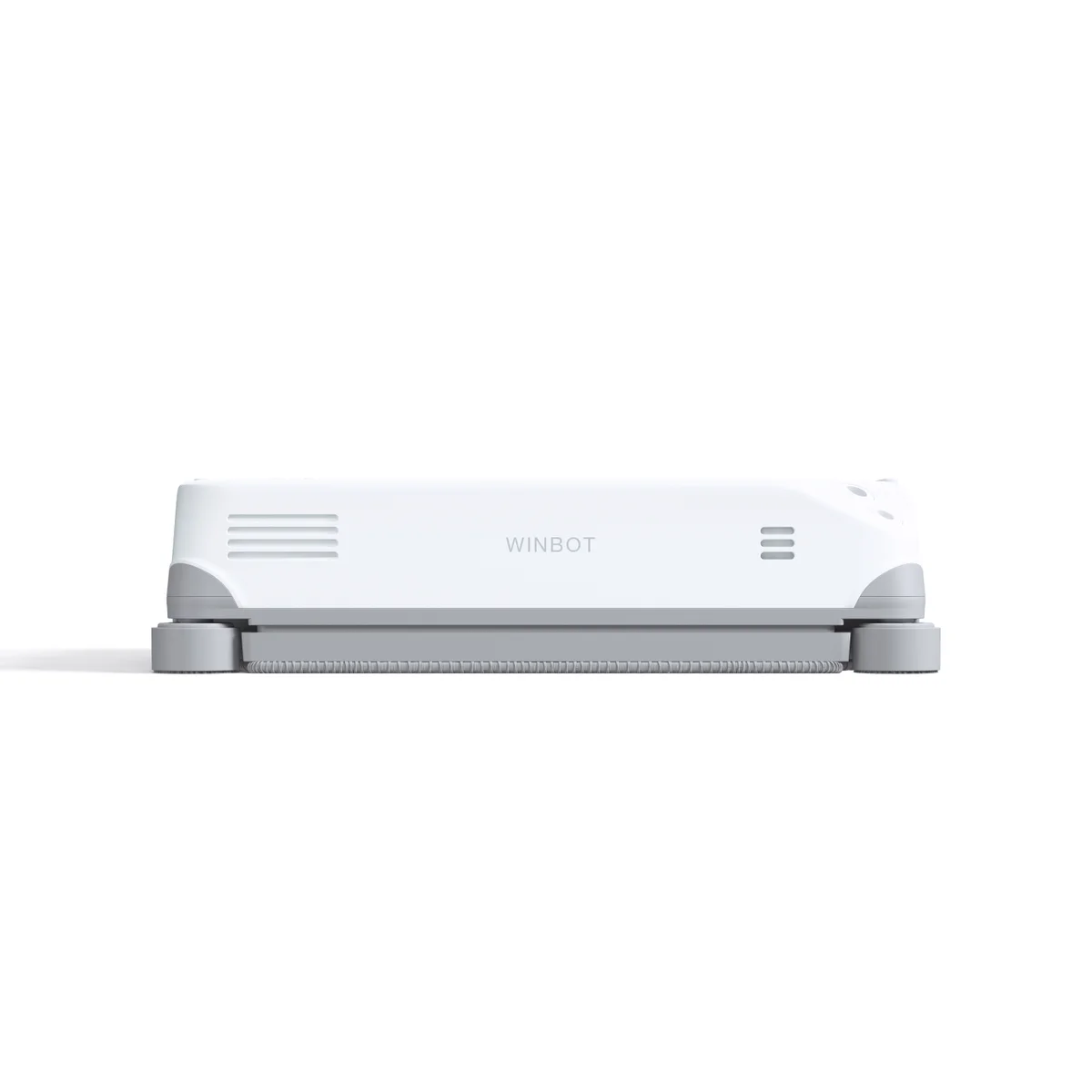
Ecovacs WINBOT mini 2
The slim Winbot for narrow panes from 25 × 25 cm: 8,000 Pa, felt brushes at all four corners, ultrasonic mist from a 50 ml tank for 30 m², WIN-SLAM 4.0 and 30 minutes of grip after a power cut.
The safety rope: what it is for and what the makers publish
Every machine we list ships with a safety rope, or with a cable that doubles as one. It is tied indoors to something fixed and is the last line if the suction fails. What a maker prints for it is a tensile or test load, not a promise, and we repeat the figure with the unit as printed and never convert it. Of the machines we list, 4 of 18 print a rating in kilograms.
- 140 kg: Dreame C1, for the 5.5 m composite cable, according to Dreame.
- 140 kg: Dreame C1 Station S, the same cable, run to the station.
- 100 kg: MOVA T1 Station, the 5.5 m two-in-one cable, "getestet" in MOVA's own word.
- 100 kg: Ecovacs WINBOT W3 OMNI, the primary rope, a three-layer composite.
The rest print a length, a different unit or nothing. HOBOT gives the SP10 iScraper and the S7 Pro a 4.5 m rope rated to 230 kgf, as HOBOT writes it. Ecovacs gives the WINBOT mini 2 a 3.3 m rope with a tensile rating of 1,900 N on its German page and 1,600 N on its US page; the WINBOT W2 PRO has a 6 m rope and the WINBOT MINI a 3.3 m one, with no rating printed. Mamibot prints a 5 m nylon rope for the iGLASSBOT W110-DP and a 4 m nylon rope for the iGLASSBOT W100 and the iGLASSBOT W110-P; the iGLASSBOT W200 SkyBot has a 1.5 m wire to an indoor fixture plus a suction cup on a 2.5 m extension; the rope of the iGLASSBOT W300 is combined with the power cable, with no length or rating printed. MOVA calls the rope of the N1 high-strength and prints no rating.
The OMNI models, the WINBOT W2 PRO OMNI, W2S OMNI, W2S PRO OMNI and W3 OMNI, hang on a 5.5 m composite cable to their station and carry a 1 m rope from the station's base. Ecovacs rates the station's suction cup at over 800 N; that is a suction-cup figure, not a rope rating.
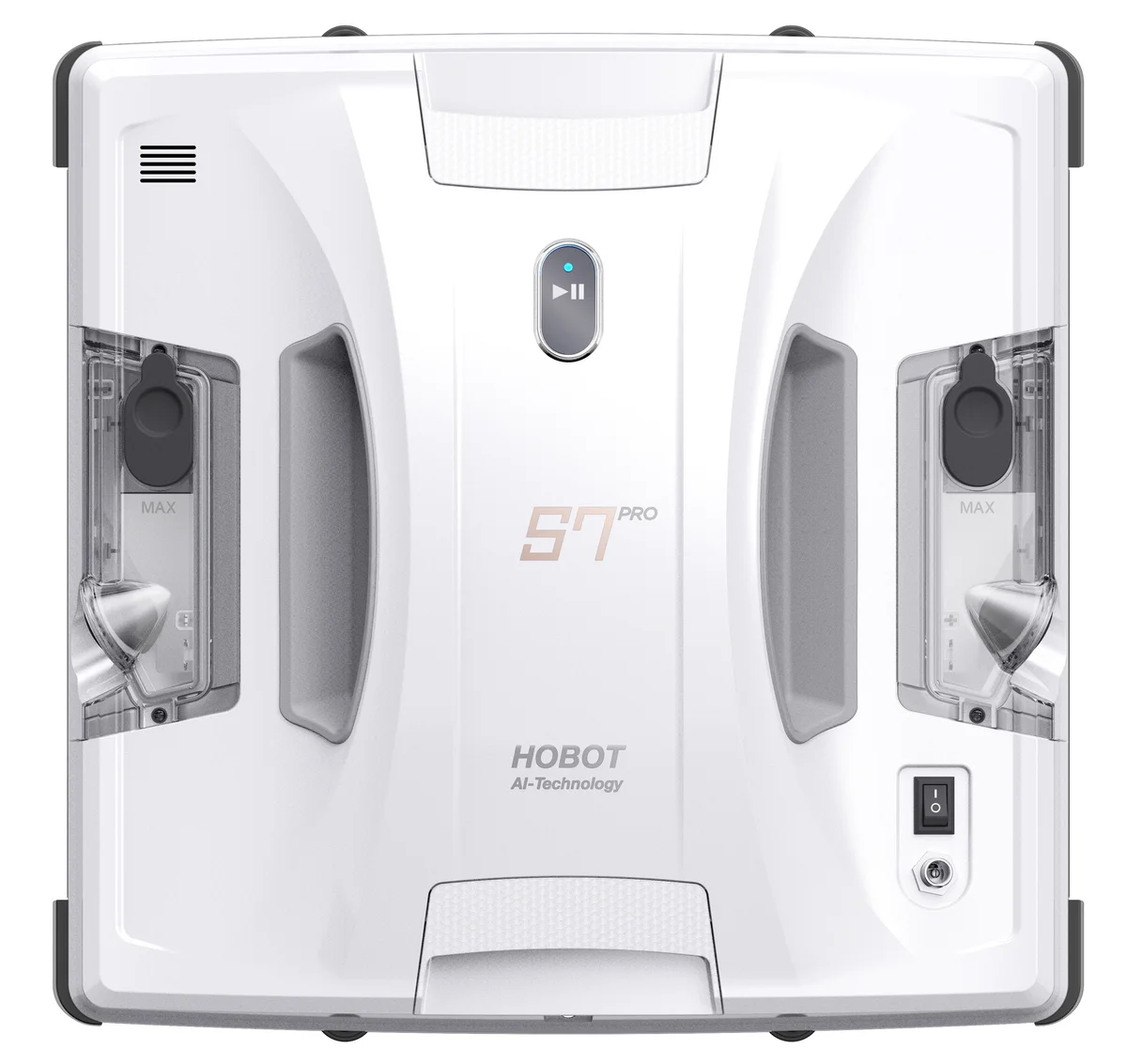
HOBOT S7 Pro
HOBOT's dual-mop polisher: two cloths reciprocating 600 times a minute behind a 15 µm ultrasonic spray, 4,800 Pa, ELB edge sensors, 12 cm/s, a 230 kgf rope and 20 minutes of grip after a power cut.
Spray and water: tank, glass per fill and nozzles
Every machine we list except the Mamibot iGLASSBOT W200 SkyBot sprays water from a tank onto the glass ahead of the pad; the W200 SkyBot has no tank and no spray, and Mamibot describes dry wiping and wet cleaning with its cloths. The tank size and the maker's glass per fill tell you how often you refill on a large pane. The nozzle counts are the makers': six on the W2 PRO, the W2 PRO OMNI, the W2S PRO OMNI and the W3 OMNI; four on the T1 Station and the W300, and four ultrasonic mist nozzles on the WINBOT MINI and the mini 2; two pressurised nozzles on the SP10 iScraper and two ultrasonic ones on the S7 Pro. Only the MOVA T1 Station heats its water, up to 40 °C when switched on in the app, and only the WINBOT W3 OMNI washes its pads in the station.
For the Dreame C1, the Dreame C1 Station S and the MOVA T1 Station the maker's figure is not a glass area per fill. Dreame gives the C1 and the C1 Station S a cleaning cycle of 60 minutes per fill, and for the C1 Station S adds about 90 m² per station charge, not per fill; MOVA gives the T1 Station up to 90 m² of wet cleaning without saying whether that is per fill or per charge. None of them gets an area below. The tanks and the areas are the makers' figures.
- 215 ml: Mamibot iGLASSBOT W300, 35 m² per fill.
- 120 ml: MOVA N1, 32 m²; Ecovacs WINBOT W2S PRO OMNI, 75 m².
- 80 ml: Dreame C1, MOVA T1 Station and Dreame C1 Station S, glass per fill Not published; WINBOT W2S OMNI, 50 m²; WINBOT W3 OMNI, 50 m².
- 60 ml: WINBOT W2 PRO, 40 m²; WINBOT W2 PRO OMNI, 40 m²; WINBOT MINI, 25 m²; Mamibot iGLASSBOT W110-DP, glass per fill Not published.
- 50 ml: WINBOT mini 2, 30 m²; Mamibot iGLASSBOT W100 and iGLASSBOT W110-P, glass per fill Not published.
Tank Not published for the HOBOT SP10 iScraper and the HOBOT S7 Pro: HOBOT prints no capacity. The W200 SkyBot has none.
How it moves and whether it reaches the corners
A round pad on a square robot leaves the corners of the pane. Makers answer with corner brushes, a scrubber that drops at the frame or a squeegee, and what we record is the claim, not the result.
Corners
- Dreame C1: CornerClean, with eight corner brushes in the box.
- MOVA T1 Station: NookSpin, four brushes, an edge distance under 1 mm according to MOVA.
- Dreame C1 Station S: four brushes turning through 360°.
- Ecovacs WINBOT W2S OMNI: a TruEdge scrubber lowered at the frame, Quad-Edge mode to 1.1 cm.
- WINBOT W2S PRO OMNI: TruEdge 2.0, flush to the frame as Ecovacs words it.
- WINBOT W3 OMNI: a TruEdge scrubber that retracts after cleaning, 1.1 mm edge precision as Ecovacs prints it.
- WINBOT mini 2: felt brushes at all four corners, up to 84 rpm, to 1 mm from the frame.
- Mamibot iGLASSBOT W300: an edge mode and a squeegee.
No corner claim from the makers of the MOVA N1, the WINBOT W2 PRO, W2 PRO OMNI and WINBOT MINI, the HOBOT SP10 iScraper, whose Dual Glide Scraper squeegee has two replaceable blades, the HOBOT S7 Pro, which wipes with two reciprocating cloths at 600 strokes a minute, and the Mamibot iGLASSBOT W200 SkyBot, iGLASSBOT W110-DP, iGLASSBOT W100 and iGLASSBOT W110-P.
Route, obstacles and resuming
Resuming matters when a handle or a power cut interrupts the run. These machines state that they carry on from where they stopped, according to their makers:
- Dreame C1 and Dreame C1 Station S.
- Ecovacs WINBOT W2 PRO, WINBOT W2 PRO OMNI, WINBOT W2S OMNI, WINBOT W2S PRO OMNI, WINBOT MINI, WINBOT W3 OMNI and WINBOT mini 2.
A return to the starting point is also claimed for the Mamibot iGLASSBOT W200 SkyBot and the iGLASSBOT W110-P. Path planning is claimed by every maker except for the iGLASSBOT W100, which Mamibot gives three routes by spray direction and no pattern. Obstacle avoidance is not claimed for the HOBOT S7 Pro, the Mamibot iGLASSBOT W300 or the W200 SkyBot. Where a speed is printed it is 14 cm/s for the Dreame C1, the MOVA T1 Station and the Dreame C1 Station S, 16 cm/s for the WINBOT W3 OMNI and 12 cm/s for the S7 Pro; the others print no speed, though several print a time per square metre, quoted on their product pages as the maker's.
Cord or battery with a station
A corded robot hangs on a cable to a socket. A cordless one, in our tables, is a robot whose job needs no socket, and 7 of 18 machines we list run from a battery. All but one carry that battery in a station the robot stays cabled to, on a 5.5 m cable, so they are not cable-free; only the Mamibot iGLASSBOT W200 SkyBot has no cable at all. Station weights as printed: 8.2 kg for the T1 Station, whose copy speaks of a 6 kg counterweight; 8.3 kg for the C1 Station S, whose copy says 6 kg; 5.5 kg for the W2 PRO OMNI, 5.2 kg for the W2S OMNI, 5 kg for the W2S PRO OMNI and 10 kg for the W3 OMNI. Mains leads, where printed: 1.8 m for the C1 and the C1 Station S, 1.2 m for the W2 PRO, the WINBOT MINI and the mini 2, and 1.8 m to the station for the W2 PRO OMNI and the W3 OMNI.
Battery, in a station or in the robot
Runtimes and capacities are the makers' figures.
- MOVA T1 Station: 80 min of cleaning out of 110 in total, the rest a 30 min suction reserve; a 4.5 Ah battery, about 180 min to charge.
- Dreame C1 Station S: runtime Not published. Dreame's table prints 4,150 mAh and 60 minutes and its copy 7,800 mAh and 180 minutes, so we record neither; about 90 m² per station charge.
- Ecovacs WINBOT W2 PRO OMNI: 110 min, 4.5 Ah, about 55 m² in fast mode and 22 m² in deep mode per charge.
- WINBOT W2S OMNI: 110 min, 4.5 Ah, about 65 and 26 m².
- WINBOT W2S PRO OMNI: 110 min, 5.2 Ah, about 72 and 26 m².
- WINBOT W3 OMNI: 130 min, 9 Ah, about 120 and 48 m², from a 10 kg station that also washes the pads.
- Mamibot iGLASSBOT W200 SkyBot: 100 min from a detachable 3.35 Ah pack, 100 min to charge, up to 30 m² per charge; a 2.4 GHz remote and no app.
On a cable to the socket
Cable lengths are the makers' figures; where none is printed, the label says so.
- MOVA N1: cable length Not published.
- 5.5 m: Dreame C1 and Ecovacs WINBOT W2 PRO.
- 3.5 m: WINBOT MINI and WINBOT mini 2.
- 4 m: HOBOT SP10 iScraper and HOBOT S7 Pro, the S7 Pro's extendable to 8 m.
- Mamibot iGLASSBOT W300, iGLASSBOT W110-DP, iGLASSBOT W100 and iGLASSBOT W110-P: cable length Not published.
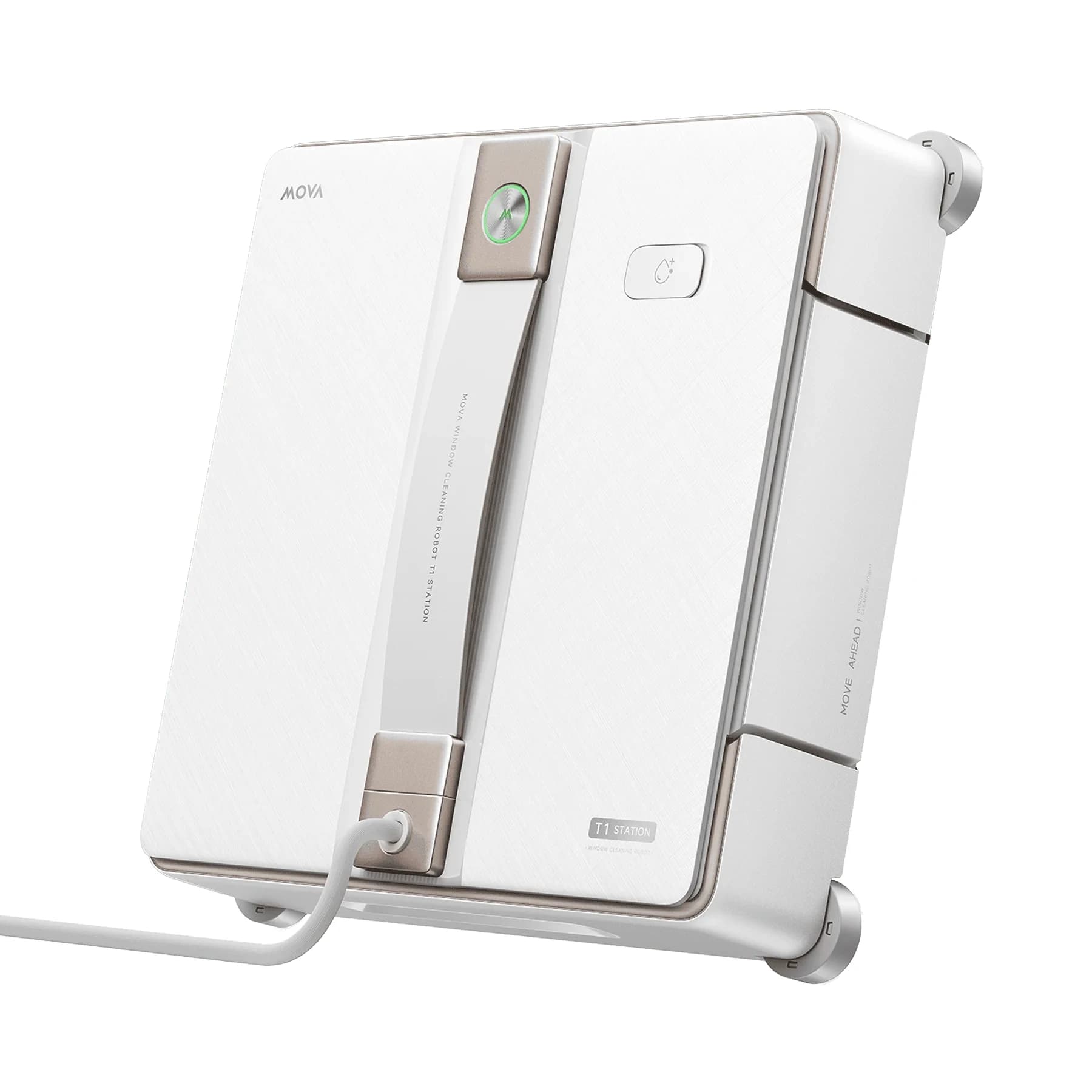
MOVA T1 Station
MOVA's first window robot with a base station: 10,000 Pa, panes to 2.5 × 8 m, rated for 90 m² of wet cleaning, an 80 ml tank with warm water, corner brushes, 80 minutes off the mains, 3-year warranty.
Noise and weight
The pump is the noise. The decibel figure is the maker's and not measured by us. Weight matters because you lift the robot onto the glass and hold it there until the suction takes.
Noise
- 63 dB: Dreame C1, Dreame C1 Station S, Ecovacs WINBOT W2 PRO, WINBOT W2 PRO OMNI and WINBOT MINI.
- 65 dB: Mamibot iGLASSBOT W200 SkyBot.
- 66 dB: WINBOT W2S PRO OMNI.
- 68 dB: MOVA T1 Station, WINBOT W2S OMNI and WINBOT W3 OMNI, whose station Ecovacs puts at 63 dB.
- 70 dB: Mamibot iGLASSBOT W300.
- 72 dB: MOVA N1.
Not published for the WINBOT mini 2, the HOBOT SP10 iScraper, the HOBOT S7 Pro, the Mamibot iGLASSBOT W110-DP, the iGLASSBOT W100 and the iGLASSBOT W110-P.
Weight
- 1.3 kg: MOVA N1, Ecovacs WINBOT MINI and WINBOT mini 2.
- 1.6 kg: Dreame C1 and WINBOT W2 PRO OMNI.
- 1.8 kg: MOVA T1 Station and WINBOT W2 PRO.
- 1.95 kg: WINBOT W2S OMNI.
- 2.1 kg: WINBOT W2S PRO OMNI and WINBOT W3 OMNI.
Not published for the Dreame C1 Station S, the HOBOT SP10 iScraper, the HOBOT S7 Pro, the Mamibot iGLASSBOT W300, the iGLASSBOT W200 SkyBot, the iGLASSBOT W110-DP, the iGLASSBOT W100 and the iGLASSBOT W110-P. Footprints, where printed: the N1, the WINBOT MINI and the mini 2 are 215 mm square and 55 to 59 mm high; the rest are about 270 mm square.
What the makers leave unpublished
Every product page shows the maker's source and the date we read it, and "Not published" means exactly that, not "none". Ecovacs prints a minimum pane and no maximum, and no noise figure for the mini 2. HOBOT prints no specification table at all, so tank, weight, dimensions, noise, pane sizes and warranty are unpublished for both of its machines; we use only its English feature copy, not the figures of its Polish distributor. Mamibot prints no weight for any model and no backup minutes for the W110-DP. Dreame prints no backup minutes for the C1 and two contradicting battery figures for the C1 Station S. MOVA prints no cable length for the N1.
Two more things only some makers say. Liability insurance: only MOVA states one, for the T1 Station, worldwide for the warranty period. A release year is printed only for the T1 Station, the W3 OMNI and the mini 2 (2026), the W110-DP and the W100 (2024) and the W110-P (2022).
Warranty
The warranty terms below are the makers' own, as their pages print them.
- 36 months: MOVA T1 Station.
- 24 months: Ecovacs WINBOT W2 PRO, WINBOT W2 PRO OMNI, WINBOT W2S OMNI, WINBOT W2S PRO OMNI, WINBOT MINI, WINBOT W3 OMNI and WINBOT mini 2.
- 12 months: Mamibot iGLASSBOT W300, iGLASSBOT W200 SkyBot, iGLASSBOT W110-DP, iGLASSBOT W100 and iGLASSBOT W110-P, plus 6 months on the battery.
Not published for the MOVA N1, whose page records an "up to 3 years" that comes from a Polish shop and not from MOVA, the Dreame C1, the Dreame C1 Station S, the HOBOT SP10 iScraper and the HOBOT S7 Pro.
Which page to open for which need
- Best window cleaning robots: the default weighting, with cleaning and safety carrying forty per cent between them (cleaning 22, safety 18, coverage 14).
- Best window robots for large windows: coverage weighted 30 in 100, so the maker's largest pane, glass per fill and route planning decide it.
- Safest window cleaning robots: safety weighted 36 in 100 and adhesion 20, so backup minutes, rope rating, fault self-check and suction decide it.
- Best value window cleaning robots: value weighted 30 in 100, capability per unit of money against the whole catalogue, with the price read from the product page and never from this guide.
All the window cleaning robots we list are on one page; Ecovacs' WINBOTs have a hub of their own; and How we score sets out how every score on this site is computed.