How to winter a robot mower: the half hour that decides whether it starts in spring
When to stop, how to store the battery, what to do with the dock and the RTK antenna, and what to check in spring, from Segway Navimow's and Mammotion's own instructions, which differ in the details.
Maciej Ziółko · RoboVerdict editorial · Published · 6 min read
When the season ends
Grass stops growing when the days stay below about 5 °C, which in Poland and Germany usually means somewhere between late October and the middle of November. A robot that keeps driving over a lawn that no longer grows only wears the turf and its own blades, and a lithium battery should not be charged in frost. Every mower in our catalogue is built for rain: 33 of the 36 publish a water rating, IPX6 or IP66. That rating describes a downpour and a garden hose, not four months of frost and wet snow. The instructions below come from the two makers that publish theirs step by step, Segway Navimow and Mammotion. They agree on the principle and differ on the details, which is the reason to follow your own maker's guide rather than a generic checklist.
1. The battery: charged, then asleep
Segway's guide for the Navimow i series says to charge the mower to at least 85 per cent and then put it into hibernation from the app, a state that uses less energy than an ordinary shutdown; a mower stored without hibernation has to be recharged once every three months, and a hibernating one must be charged before it will wake. Mammotion's guide for the YUKA says to cancel every scheduled task in the app first, so the machine cannot start itself in storage, then charge the battery completely, power off, pull the key and keep it somewhere else. Both rules protect the same thing: a lithium pack left empty for months can sink below the level it recovers from, and that is a repair rather than a recharge.
2. Cleaning: water yes, pressure no
Here the two guides part ways. Segway has the owner take the blades off with gloves on, turn the Navimow i upside down, brush it, rinse the dirt off with a garden hose and let it dry completely. Mammotion wants the YUKA wiped with a soft damp cloth and the camera modules cleaned with a lint-free one; the underside may be rinsed with household water, never with a pressure washer, and the mower is then left flat to dry for at least half an hour and explicitly not turned upside down, so that water cannot run into the wrong compartments. Neither maker allows a high-pressure jet, whatever the water rating says.
3. Blades and contacts
Both guides start with protective gloves. Mammotion sets the cutting disc to its highest position, unscrews the blades, cleans the disc with a brush and a damp cloth, and fits new blades with fresh screws before storage, so that the first cut of spring is a sharp one. It then puts a light film of anti-corrosion lubricant on the charging contacts of the mower and of the station, and nowhere else, and suggests checking the data used on the 4G card while the machine is open. Segway's list is shorter: blades off, mower cleaned, everything dried.
4. The dock and the antenna
Segway has the Navimow's charging station unplugged, unscrewed and brought indoors, and gives the detail that saves an hour in spring: mark the four screw holes with the silicone pegs from the box and leave the pegs in the lawn. An antenna on a wall or roof is covered with a bag or a cap; an antenna on a ground pole is unscrewed from the pole and the pole stays where it is, because moving the antenna means making a new map. Everything goes back into the box and is stored dry and frost-free, between 5 and 45 °C. Mammotion also brings the station in with the mower, to a dry room above freezing, and sets a hard limit: below minus 20 °C the mower, the station, the RTK reference station and its solar panel must all be indoors. That paragraph matters most for the six machines in our catalogue that still need their own antenna, the Mammotion LUBA 2 AWD and YUKA 1500, the Anthbot Genie 600e, Genie 1000 and Genie 3000 and the Navimow i105E; the other thirty position by network RTK, LiDAR or cameras and have nothing on a mast, as the positioning guide explains.
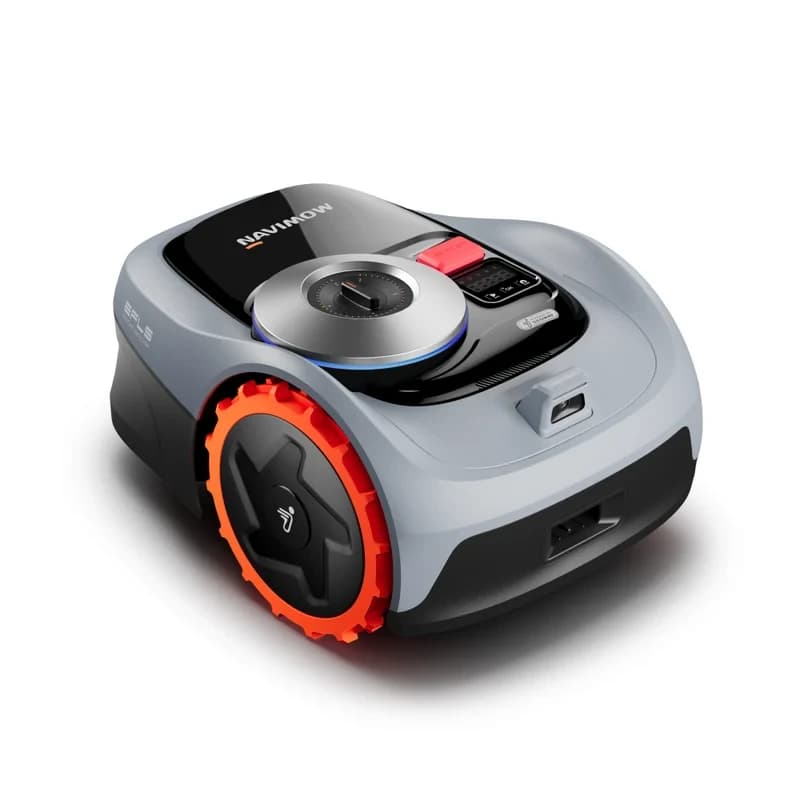
Segway Navimow i105E
Segway's entry Navimow for Europe: RTK positioning with a visual SLAM fallback, a 140° camera that knows 150 obstacle types, an 18 cm cut, 30% slopes, 120 minutes a charge and 58 dB, for 500 m².
5. Spring: a quarter of an hour before the first cut
Segway's spring guide runs the winter one backwards. The antenna goes back on its pole, the station back onto the marked holes and onto power, still unscrewed. The mower is switched on beside the station and sent home; if it docks and charges, it is given a mowing task, and only when it leaves, mows and reports no error in the app is the station screwed down. Last comes the firmware, because updates are released over the winter: the mower has to stand in the station with a good signal, more than 20 per cent of charge and no mowing scheduled for the next hour.
Dreame, MOVA and the rest
Dreame's guide to the A2 and MOVA's guide to the LiDAX Ultra both list a chapter on the battery and winter storage, and both keep its content in the manual and the app rather than on a public page. We do not repeat figures we cannot cite, so for those machines, and for eufy and Anthbot, the advice is the principle the two published guides share and the chapter in your own manual for the numbers.
The short version
- Stop when the grass does, at about 5 °C by day, and before the first hard frost.
- Cancel the schedule, charge the battery to the level your maker names, then switch off or hibernate; without hibernation, recharge every three months.
- Clean with a brush, a cloth and gentle water. Never a pressure washer, and dry the machine completely.
- Blades off with gloves on; fit new ones now or in spring.
- Unplug the station, mark where it stood and store it with the mower, dry and frost-free.
- Leave the antenna pole where it is. A moved antenna means a new map.
- In spring: station back on its marks, a test run before screwing it down, then the firmware update.
Sources: Segway Navimow's winter storage guide and spring guide for the i series, and Mammotion's winter care guide for the YUKA, all read on 18 September 2026. If the mower is due for replacement rather than storage, the ranking of wire-free mowers is where next season starts.